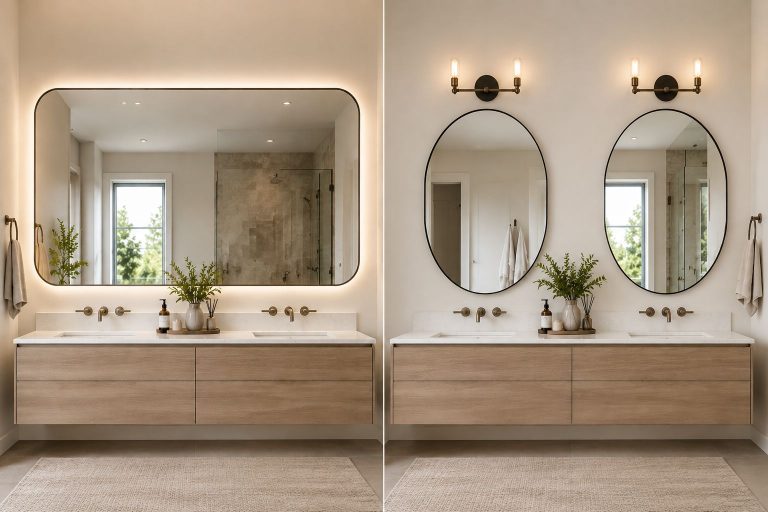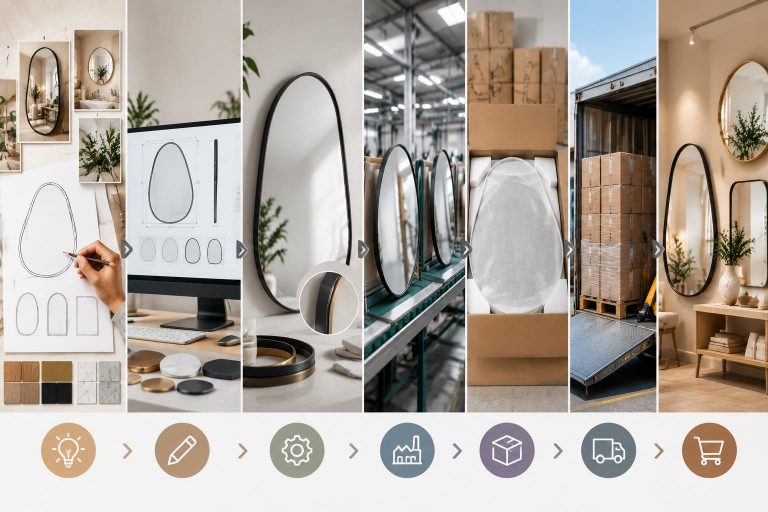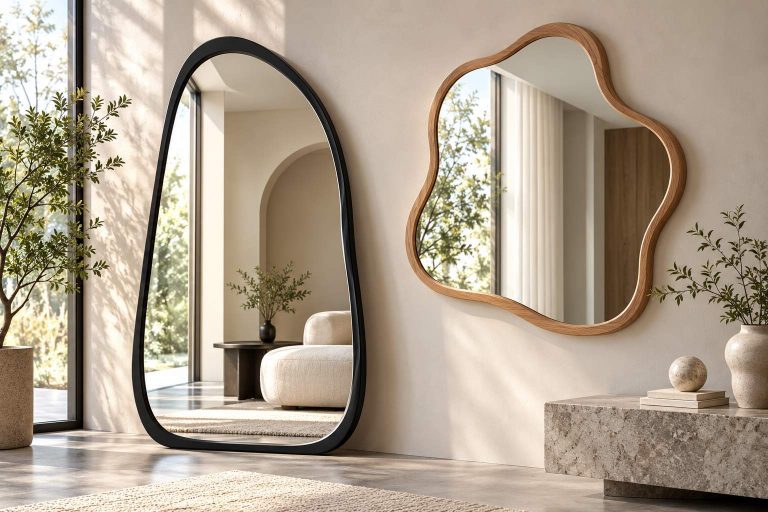
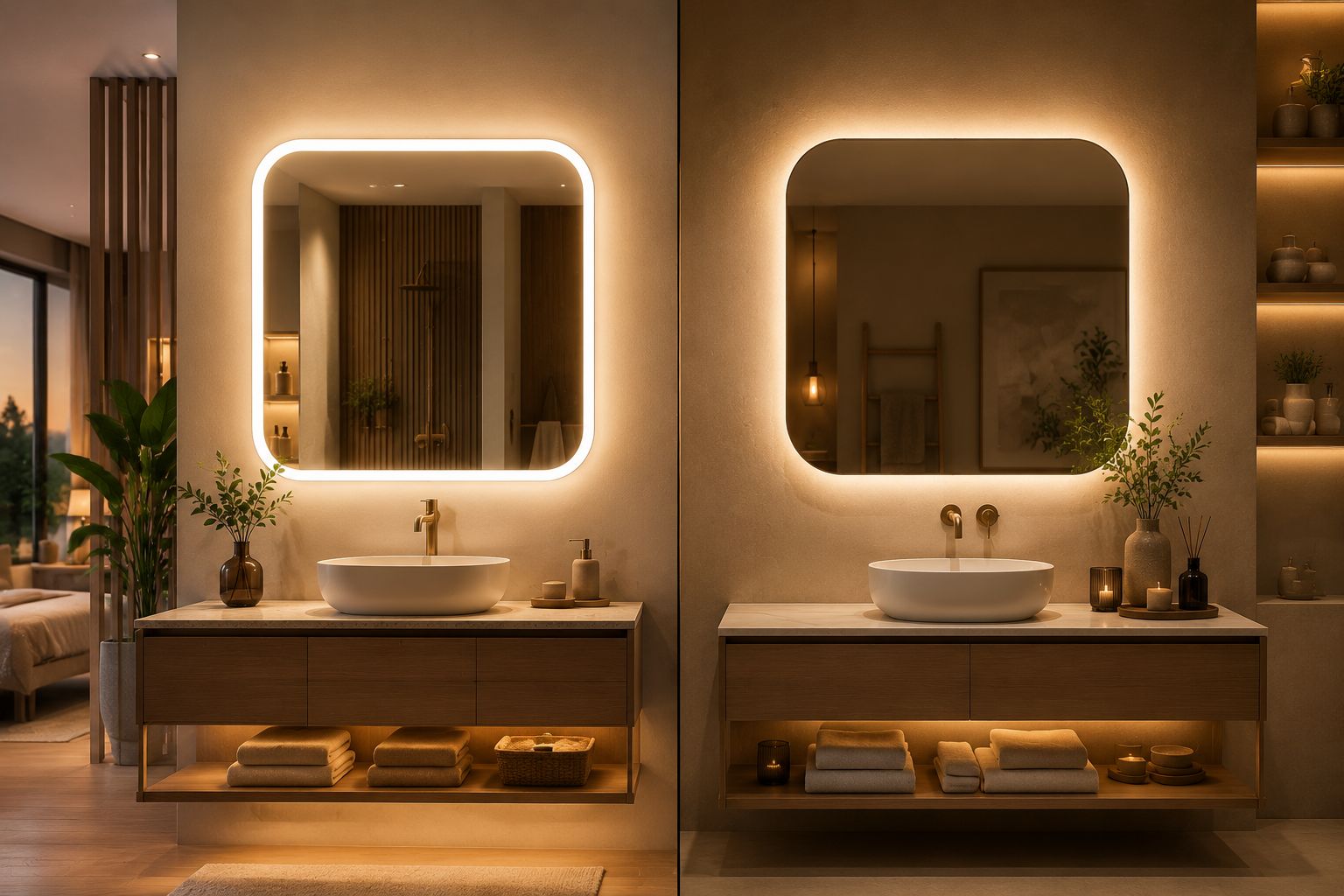
Retail demand in 2026 favors illuminated mirrors that combine useful light with a clear design identity. Front-lit models usually have the broader sales case because shoppers immediately connect the light with grooming. Backlit mirrors fit premium, spa-oriented bathrooms where atmosphere matters more. NKBA’s 2026 Bath Trends research found that lighting quality remains a leading bathroom priority and that integrated mirror lighting continues to attract design interest, but it does not show one format winning every channel. Retailers still need to match the lighting style to the customer, price tier, and room layout.
Which illuminated mirror has the stronger retail sales case in 2026?
For a broad assortment, front-lit mirrors are usually the safer volume choice. LEDs face forward through frosted bands, so customers see light directed toward the face for makeup, shaving, contact lenses, and routine grooming.
Where do front-lit mirrors sell more consistently?
Front-lit models suit buyers who treat the mirror as a working bathroom fixture. They are useful in compact rooms where side sconces are impractical. Adjustable brightness, selectable color temperature, and anti-fog control also create visible selling points.
Their limitation is visual. A wide luminous border can dominate the glass, while poor diffusion creates hotspots or a harsh ring effect. Entry-level models may also look similar across competing listings.
When can backlit mirrors outperform them?
Backlit mirrors can sell strongly in premium renovation and design-led collections. Light projected onto the wall creates a floating outline and softer atmosphere, matching the current interest in layered bathroom lighting.
Backlighting alone may leave the face underlit. Its sales performance therefore depends on whether the bathroom already has ceiling or vanity lighting. Retailers should present it as ambient or layered light rather than a replacement for every task-light source.
How does lighting placement change real bathroom performance?
Front lighting sends more light toward the user. Backlighting sends light toward the wall and relies on reflection around the mirror perimeter. That basic difference affects both installation and daily use.
Why does wall condition matter for backlit mirrors?
A backlit mirror needs clearance behind the glass and a reasonably even wall. Wall color, texture, mounting distance, and tile finish affect the halo. Dark stone absorbs more light than pale tile, while an uneven wall can produce irregular brightness.
The installer also needs space for the driver, wiring, brackets, and anti-fog connections. Too little clearance weakens the floating effect; too much can make the mirror look bulky from the side.
What makes front lighting useful for grooming?
Front-lit bands reduce dependence on reflected wall light. Placement still matters. Light concentrated only at the top can create shadows below the eyes and chin, while vertical side bands often distribute illumination more evenly.
Color appearance should be specified rather than described as “daylight.” Correlated color temperature indicates whether light appears warmer or cooler, while CRI describes color shift compared with a reference source. Retailers should confirm CCT settings, stated CRI, dimming range, and memory behavior.
Which specifications should retailers compare before placing an order?

A mirror can look convincing in a photograph while using components that create returns later. The purchasing specification should cover optical, electrical, mechanical, and packaging details.
Which lighting specifications affect customer satisfaction?
Compare luminous output, LED spacing, diffuser width, CCT options, CRI, dimming, flicker, color consistency, and control response. For backlit models, inspect uniformity around corners. For front-lit designs, check whether individual LED points remain visible through the frosted bands.
The anti-fog pad should be defined by its heated area. A small pad may clear only the center. Buyers should also confirm whether it operates with the light, through a separate control, or on a timer.
Which construction details affect installation and returns?
Specify mirror thickness, edge treatment, backing, total depth, mounting system, driver location, input voltage, plug or hardwire arrangement, and cable exit. Touch switches should remain responsive without false activation from moisture or cleaning.
Serviceability is worth considering. An accessible driver or connection box may simplify repair. Packaging must protect the glass, corners, controls, and rear components through the intended delivery route.
What quality and compliance risks should buyers control?
Illuminated bathroom mirrors combine glass, electronics, wiring, adhesives, heating elements, and mounting hardware. A cosmetic inspection alone is not enough.
Which defects are common during inspection?
Inspect reflection distortion, scratches, edge chips, coating defects, light leakage, dark sections, inconsistent color, driver noise, flicker, touch-control delay, loose wiring, and uneven anti-fog heating. The rear structure should sit flat, and brackets should match the approved location.
A functional test should cover every setting and control sequence. Temperature rise, insulation, grounding where applicable, moisture protection, and strain relief should follow destination-market requirements. Changing a driver, switch, LED strip, or wiring layout may affect compliance.
How should certification claims be verified?
Request documents tied to the exact model, voltage, component configuration, and market. A certification logo on packaging is not enough. UL Solutions has warned about an LED bathroom mirror carrying an unauthorized UL mark, showing why model and certification records need direct verification.
Incoming inspection should compare labels, ratings, wiring, plugs, and controls with the approved sample. Unexplained substitutions should be resolved before shipment.
How should retailers build an assortment and evaluate suppliers?
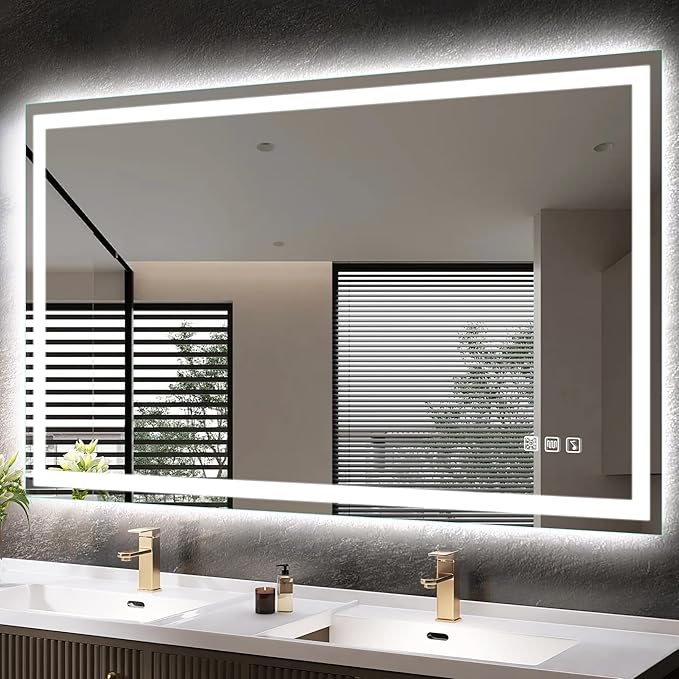
A practical 2026 assortment does not need to choose one lighting style exclusively. It needs clear roles for each model so similar products do not compete only on price.
How should the range be divided?
Front-lit mirrors fit an opening or mid-range tier focused on grooming and visible features. Backlit models fit design-led collections where shape, wall glow, thin profiles, and finishes drive the purchase. Hybrid lighting can occupy a higher tier, although extra components raise cost and create more inspection points.
Start with a limited number of proven sizes and shapes. Vary features customers can compare: CCT control, dimming, anti-fog area, frame finish, and switch type. Pilot sales are more useful than ordering a wide catalog from renderings.
What should a supplier prove before repeat orders?
Review drawings, component lists, electrical documents, inspection procedures, packaging, lead time, minimum order quantity, and change control. Samples need evaluation in a realistic bathroom, both with other lights on and with the mirror as the main source.
Retain an approved sample and require notice before changes to the driver, LED strip, glass, backing, switch, heater, hardware, or packaging. Customers notice when brightness, color, depth, or controls change between batches.
How can a mirror supplier support an illuminated mirror program?
Qingdao Yinlongfei Handicraft supplies mirrors for retail, wholesale, and private-label programs. A project brief should state dimensions, shape, lighting layout, CCT options, dimming method, anti-fog area, switch type, voltage, plug or hardwire requirements, backing, hardware, packaging, and order quantity. Samples should be reviewed in lit and unlit conditions for light uniformity, reflection quality, touch response, edge finish, rear clearance, and carton protection. Quotations should identify the approved electrical configuration, inspection items, packaging method, lead time, and change-notification requirements. Repeat orders should remain tied to the same drawing, sample, label artwork, component list, and acceptance criteria for production approval and warehouse receiving checks.
Conclusion
Front-lit bathroom mirrors are more likely to deliver steady sales across general retail channels because their task-lighting function is immediately clear. Backlit mirrors can perform better in premium and design-led collections where atmosphere carries more weight. Neither format wins every market. Retailers should base the decision on customer use, surrounding lighting, price tier, electrical compliance, component quality, and display strategy. A controlled assortment with distinct roles for front-lit, backlit, and hybrid models reduces overlap and purchasing risk.
FAQs
1. Do front-lit bathroom mirrors sell better than backlit mirrors?
Front-lit models usually have broader appeal because shoppers recognize their grooming function quickly. Backlit mirrors may sell better in premium collections where ambient light and a floating visual effect drive the purchase.
2. Is a backlit bathroom mirror bright enough for makeup?
It depends on the mirror output, wall reflection, room lighting, and mounting distance. Backlighting often works better as ambient light and may need ceiling or side lighting for detailed makeup.
3. Which features matter most when buying LED bathroom mirrors wholesale?
Check light uniformity, CCT settings, CRI, dimming, anti-fog coverage, driver quality, switch response, mirror thickness, electrical documentation, mounting hardware, packaging, and control of component changes.
4. Are hybrid front-lit and backlit mirrors worth stocking?
They can suit a higher price tier by combining facial illumination with wall glow. Retailers should balance the visual benefit against higher cost, power use, component count, and inspection requirements.
5. What should retailers test before approving a backlit bathroom mirror?
Test the mirror on representative wall finishes and verify halo uniformity, corner brightness, rear clearance, driver noise, controls, anti-fog coverage, mounting stability, electrical labeling, and packaging protection.