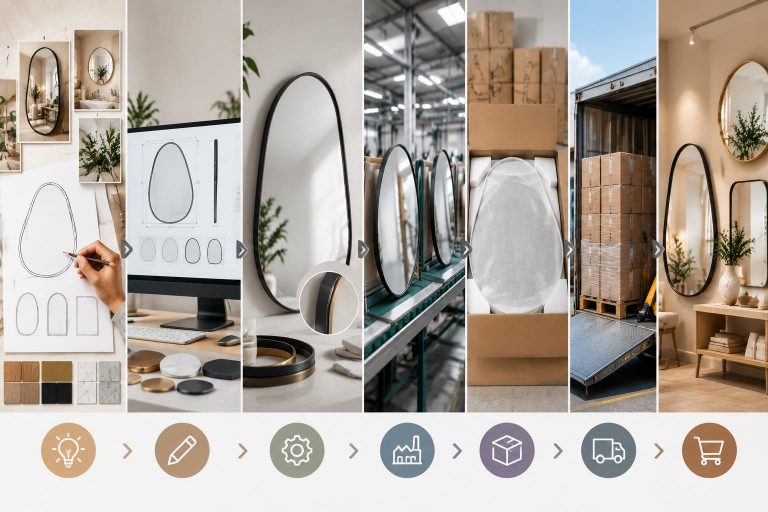

Retail buyers now need more than an attractive frame and a competitive unit price. They may also need product-level evidence for responsible sourcing policies, marketplace claims, and ESG reporting. FSC-certified mirrors can help when the frame, backing, or other forest-based components move through a verified chain of custody. The certification does not apply to the glass itself, nor does it replace normal product testing. Its value is traceability: eligible wood-based material can be linked to an approved FSC claim through purchasing, production, labeling, and sale.
How do FSC-certified mirrors strengthen sustainability evidence?
FSC chain of custody certification tracks eligible forest-based material through sourcing, manufacturing, and distribution. A finished product carrying an FSC label indicates that the certified material remained within the required control system. Independent certification bodies assess certificate holders.
What does the FSC claim cover on a mirror?
For a framed mirror, the claim concerns qualifying forest-based content, such as a solid-wood frame, engineered-wood frame, or wood-based backing included in the certified product scope. It should not be presented as certification of the glass, coating, metal hanger, adhesive, or every packaging component.
The exact claim matters. FSC uses several label categories, including FSC 100%, FSC Mix, and FSC Recycled. Retailers should obtain the product claim and approved label artwork rather than use “FSC-certified” loosely for any mirror containing wood.
Why is traceability useful to retail buyers?
Traceable claims give procurement teams a defined record to review: supplier certificate status, product scope, invoice claim, label, and item number. That is more defensible than a general statement that the timber is “sustainable.”
It also helps assortment management. Buyers can separate certified lines from non-certified lines, maintain accurate product-page wording, and answer customer or marketplace questions without relying on undocumented factory assurances.
Which mirror specifications still require separate evaluation?
FSC certification addresses forest-based sourcing and chain-of-custody controls. It does not, by itself, confirm mirror clarity, frame strength, moisture resistance, hanging safety, or packaging performance. Those points remain part of product qualification.
Which frame and glass details affect performance?
The specification should identify frame material, profile dimensions, joint method, finish, backing construction, mirror thickness, edge treatment, and hanging hardware. Solid wood may show natural grain and moisture movement. MDF or other engineered wood can support repeatable profiles but needs suitable edge sealing and humidity control.
Inspect the reflection for distortion, scratches, black spots, coating defects, and edge damage. Frame corners should close cleanly, the mirror should sit securely, and the hanging system should match the product’s weight and intended orientation. ASTM C1503 addresses properties such as reflectance, coating appearance, blemishes, dimensions, and squareness for silvered flat glass mirrors.
How should packaging be considered?
Mirrors fail differently from other décor items. Corner impact can open joints, concentrated pressure can crack glass, and carton movement can damage the reflective coating or finish. Packaging should be approved with the final dimensions and hardware installed.
Retailers should confirm inner protection, corner blocks, carton strength, labeling, pallet pattern, and handling orientation. E-commerce distribution may need a different pack because parcel networks expose cartons to repeated drops and mixed handling. Packaging tests should reflect the actual distribution route rather than an unrelated shipping environment.
How can retailers verify an FSC claim before ordering?

A logo on a sample or catalog page is not enough. The supplier’s certificate, product scope, sales-document claim, and on-product label must align. Organizations manufacturing or selling products with FSC claims generally require chain of custody certification, while many retailers promoting finished, labeled goods may use a promotional licence. The correct arrangement depends on the retailer’s activity.
Which documents should procurement request?
Ask for the certificate code, current certificate status, product-group scope, exact FSC claim, approved label artwork, and a sample invoice or packing document showing how the claim will appear. The purchase-order description should match the certified product reference.
Do not assume a supplier certificate covers every product made at the site. If the frame material, factory, subcontractor, or assembly route changes, the product may require renewed review before the same claim is used.
What should retailers check in marketing materials?
Product titles, shelf cards, packaging, and online listings should use approved wording and artwork. Retailers wishing to use FSC trademarks in broader promotion should confirm whether chain of custody certification or an FSC promotional licence applies.
Marketing teams should avoid implying that certification covers unrelated performance or the product’s entire environmental footprint. A precise statement about responsibly sourced forest-based material is more credible than a broad “eco-friendly mirror” claim.
What quality and compliance risks can still create claims?
A certified frame can still warp, split, arrive damaged, or fail to match the approved color. Sustainability documentation and product quality control need separate acceptance criteria.
Which defects should be checked before shipment?
Inspection should cover overall dimensions, diagonal squareness, joint gaps, finish, color consistency, mirror seating, backing attachment, hardware location, and carton condition. A hanging trial can reveal loose keyholes, weak brackets, or imbalance that a tabletop check misses.
Humidity deserves attention for wood-based frames and backboards. Samples should be conditioned for the target market and evaluated for swelling, bowing, finish cracking, or joint movement. The suitable method depends on material, destination, and expected use. Mirror-glass inspection should use defined criteria because standards distinguish properties such as coating condition, blemishes, dimensions, and squareness.
How can claim and product mix-ups be prevented?
Certified and non-certified items may look identical after finishing. Clear item codes, controlled labels, segregated records, and batch identification reduce the chance of applying an FSC claim to the wrong product. Chain-of-custody systems require certified material and claims to be identified and controlled through production and sale.
Retailers should retain approved samples, drawings, packaging artwork, and claim documents. When a later order changes the frame profile, backing, finish, or production site, both quality and certification implications need review.
How should retailers compare FSC-certified mirror suppliers?

The strongest supplier is not simply the one that can show a certificate. Retail buyers need consistent products, usable documentation, change control, and packaging suited to the distribution route.
Which supplier controls reduce sourcing risk?
Compare certificate scope, claim accuracy, material records, subcontracting controls, product specifications, inspection procedures, and traceability. Ask how the supplier prevents certified and non-certified materials from being mixed incorrectly and how label use is approved.
Commercial details also matter: minimum order quantity by design, sampling lead time, carton customization, replacement procedures, and notice of material changes. These points determine whether a certified collection can be replenished without repeated requalification.
How should a pilot order be structured?
Start with a limited set of sizes and finishes representing the intended assortment. Approve the physical sample, FSC claim, label position, carton artwork, barcode, hardware pack, and inspection checklist before production.
During the pilot, compare received goods with the approved reference and confirm that documents carry the expected claim. Resolve any mismatch before expanding the range. A controlled launch is more informative than approving many designs from small showroom samples.
How can a mirror supplier support an FSC-certified retail program?
Qingdao Yinlongfei Handicraft supplies mirrors for retail, wholesale, and private-label programs. Buyers can submit frame material, dimensions, finish, glass thickness, backing, hanging hardware, packaging, label position, and order quantity. For an FSC-certified line, the inquiry should identify the required claim, destination market, and planned product wording. Samples can be checked for frame joints, reflection quality, hardware placement, carton protection, and document consistency. Quotations should state the approved construction, packaging method, lead time, inspection points, and change-notification requirements. Repeat orders should remain linked to the approved item code, sample, label artwork, FSC documentation, and receiving inspection criteria for purchasing and warehouse teams.
Conclusion
FSC-certified mirrors give retailers a clearer way to substantiate responsible sourcing for eligible wood-based components, but certification is only one part of product approval. Buyers still need to assess frame construction, glass quality, hardware, humidity exposure, packaging, and repeat-order consistency. The purchasing file should connect the certificate scope, product claim, label, invoice wording, approved sample, and inspection criteria. That combination supports credible sustainability communication without overlooking ordinary quality and delivery risks.
FAQs
1. Does FSC certification cover the glass in a mirror?
No. FSC applies to eligible forest-based materials and their chain of custody. On a mirror, the relevant content may include the wood frame or backing, not the glass or metal hardware.
2. Can a retailer advertise finished FSC-certified mirrors without certification?
Many retailers promoting finished, labeled FSC products may use a promotional licence rather than chain of custody certification. The correct route depends on whether the retailer relabels, processes, or sells with FSC claims.
3. What documents should accompany FSC-certified mirror orders?
Buyers should request the supplier certificate code, product scope, exact FSC claim, approved label artwork, item specification, and sales documents showing the claim associated with the ordered product.
4. Does an FSC label prove that a mirror is durable?
No. FSC certification concerns responsible forest-based sourcing and traceability. Frame strength, mirror quality, moisture resistance, hardware security, and packaging performance require separate specifications, samples, and inspection.
5. How should retailers compare FSC-certified mirror suppliers?
Compare certificate scope, claim accuracy, frame construction, quality controls, packaging, traceability, change management, lead time, and repeat-order consistency rather than relying on the presence of an FSC logo alone.