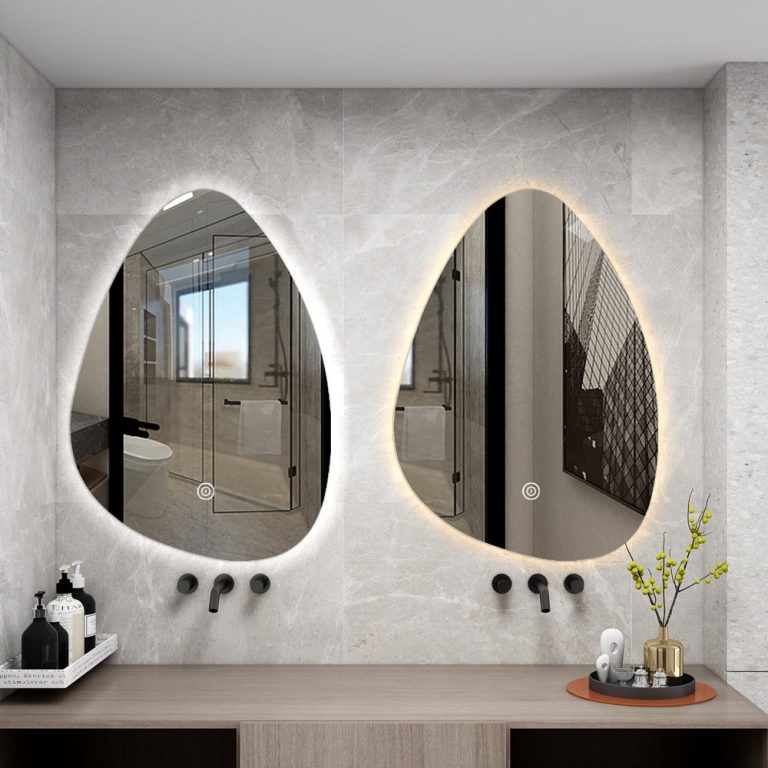
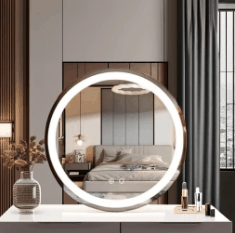
The phrase “turned on by itself” skips the most useful detail: what changed just before the lamp did. Perhaps liquid travelled across the icon under a cloth. After a shower, separate beads may have grown until they touched. The response might instead arrive with mains power or with a small shift of the mirror panel. Each timing involves a different route to the control and cannot, by itself, be called sensor failure.
Does the Response Track a Moving Film of Water?
A finger changes the electrical field near a capacitive sensing area through the glass. Water can alter that field as well. Cleaning carries a film quickly across the icon, whereas shower condensation builds in place. Their different timing helps separate the two.
What makes wiping a distinct trigger?
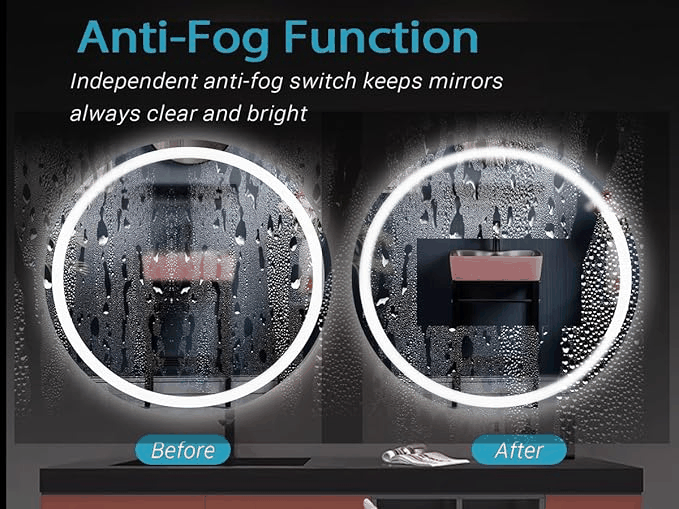
Under a damp cloth, the liquid layer reaches the icon during a single pass. If the lamp changes then, while the same dry movement leaves it stable, the wet layer is part of the trigger. Cleaner sprayed on the face may behave differently again because it can form a continuous run from the icon to an edge or metal trim.
A thin film may outlast visible drops. Following the stated cleaning method and letting the face dry removes the film without touching rear connections. When only the damp pass brings the symptom back, the event stays tied to the front surface. It does not yet prove the controller has failed.
When in the condensation cycle does the response appear?
Shower moisture changes the surface step by step. First comes a diffuse mist; later, individual drops enlarge and bridge the glass over the switch. A light that changes at that later stage follows a developing water path. As ventilation dries the area, loss of the response at the same time provides the reverse half of that pattern.
Dry, clean glass breaks this link. If the event continues in that condition, repeated exposure to steam is no longer the best route to an answer; the timing around power or movement behind the panel becomes more relevant.
Does the Output Change Exactly When Power Returns?
After an interruption, the controller may load a remembered state or its starting default. The light can then come back at another brightness or colour without the sensing area seeing a touch. Whether the touch indicator reacts helps separate that start-up sequence from a sensor input.
What is visible at the moment the supply returns?
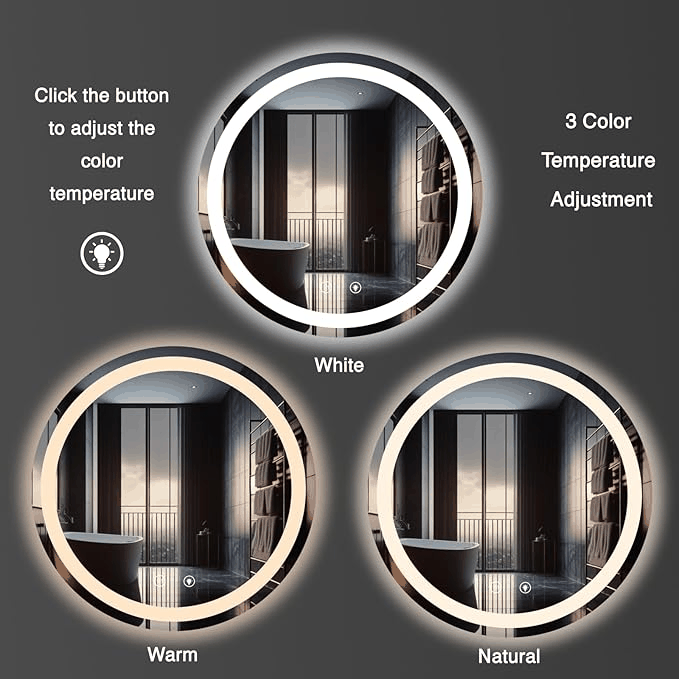
Compare the dry mirror immediately before and after restoration, with nobody near the icon. Repetition at the same instant ties the change to start-up: the supply returns, then the same output state appears. A moisture-related event would instead follow conditions on the glass.
If several mirrors react together after a wall switch or protective device operates, the shared timing shifts attention toward their common circuit. That relationship can be reviewed by a qualified electrician against the product instructions and project drawings. Local wet-area rules govern any work involving supply, grounding, bonding, or protective devices.
Why can panel movement point behind the glass?
A response immediately after pressure on one corner or movement of the panel has a mechanical companion. Once power has been isolated, the rear area can be viewed for loose connectors, damaged insulation, a trapped sensor lead, or traces of moisture without exposing anyone to energized parts.
The electrical surroundings of a capacitive control can influence it. Cables lying near one another show only where they are, not whether they caused the event. The connection becomes persuasive when movement at that one location repeatedly starts or stops the event while the glass and supply state do not change.
Does the Pattern Travel With One Mirror or Remain in the Room?
A matching unit helps distinguish a local component or connection from a room condition. The units need the same approved control arrangement; similar mirror shape is not enough.
What does repeating the original timing show?
The comparison begins with the trigger already observed. Wiping is recreated with the approved cloth and cleaner. Condensation is allowed to build and clear in its usual way. A power event is repeated with a dry face and the permitted restoration sequence. Keeping the three sequences apart lets each result point back to one kind of trigger.
A video that keeps the icon and changed output in view can capture the interval between trigger and response. During the wipe, after droplets meet, exactly at power return, or after panel movement are not interchangeable descriptions.
What changes when the unit moves to another suitable location?
If one mirror carries the same dry symptom to another suitable location while a matching unit remains stable, the evidence moves with that mirror. When several units respond together only on one circuit, it stays with the location.
Neither result automatically identifies a part. It places a boundary around the cause: one tied to the room should remain there, while one tied to the mirror should travel with it. This prevents a room-level condition from prompting wholesale controller replacement and prevents a travelling unit fault from being blamed solely on its first circuit.
Can the Earlier Trigger Reproduce the Event After a Repair?
The earlier trigger provides the closest comparison after a change. When an intermittent event happens to disappear after a new part is fitted, the timing still needs to be recreated before that part can be credited with removing the cause.
What changes for each trigger pattern?
Wipe-related activation brings the approved care method and liquid route into focus. Condensation adds ventilation, sealing, intended bathroom conditions, and sensor response as moisture develops. A repeatable change at power return shifts the question to supply and controller start-up. A dry event attached to one mirror shifts it to that unit’s rear connections or control parts.
The same wet pass can challenge a surface-related change; the same dry restoration can challenge work on the power path. Light, dimming, colour selection, and any fitted demister must still behave as intended afterward. Switching off the affected function removes the symptom from view but does not correct its cause.
Which events belong to the same affected group?
Controller version, shipment, circuit, room, and trigger timing reveal which reports belong together. One unit can justify examining related stock but does not establish one cause across it. In the opposite direction, several mirrors changing together on a circuit should not be counted immediately as separate component failures.
For supplier review, the sequence matters more than the label “ghost touch.” The changed output, untouched icon, ordered control, and result from a matching unit allow the actual path to be recreated.
Need Product Support for an LED Mirror Control Investigation?
Qingdao Yinlongfei Handicraft makes mirrors and other home-decoration products. Published information for the Kingwin Round Smart LED Mirror lists wall mounting, illumination, a smart touch sensor, dimming, colour-temperature selection, and an optional demister. That feature list establishes the product context, not why a particular installed mirror changed state. The installation and the trigger timing still have to supply that link.
Conclusion
The change before the response locates the path. Liquid moving with a cloth points to the glass surface. Droplets joining slowly point to condensation. At supply return, exact repetition fits start-up behaviour; after panel movement, it draws attention to the area behind the mirror. The same timing provides the most direct way to see whether a correction has altered the fault.
FAQs
Can growing condensation affect a capacitive switch?
Yes, because joined droplets can alter the field at the sensing area. A response that appears and clears with the visible water pattern supports the connection without identifying a failed component.
Should cleaner be sprayed directly on the touch icon?
Use the supplied care method. Applying an approved cleaner to a cloth usually controls the liquid path better than direct spray.
Does a no-contact event prove the sensor needs replacement?
No. Surface moisture, start-up behaviour, the shared circuit, rear connections, cable position, or the controller may be involved.
What should a diagnostic video include?
Keep the untouched icon and changed output visible, together with the preceding wipe, condensation, power restoration, or panel movement.