
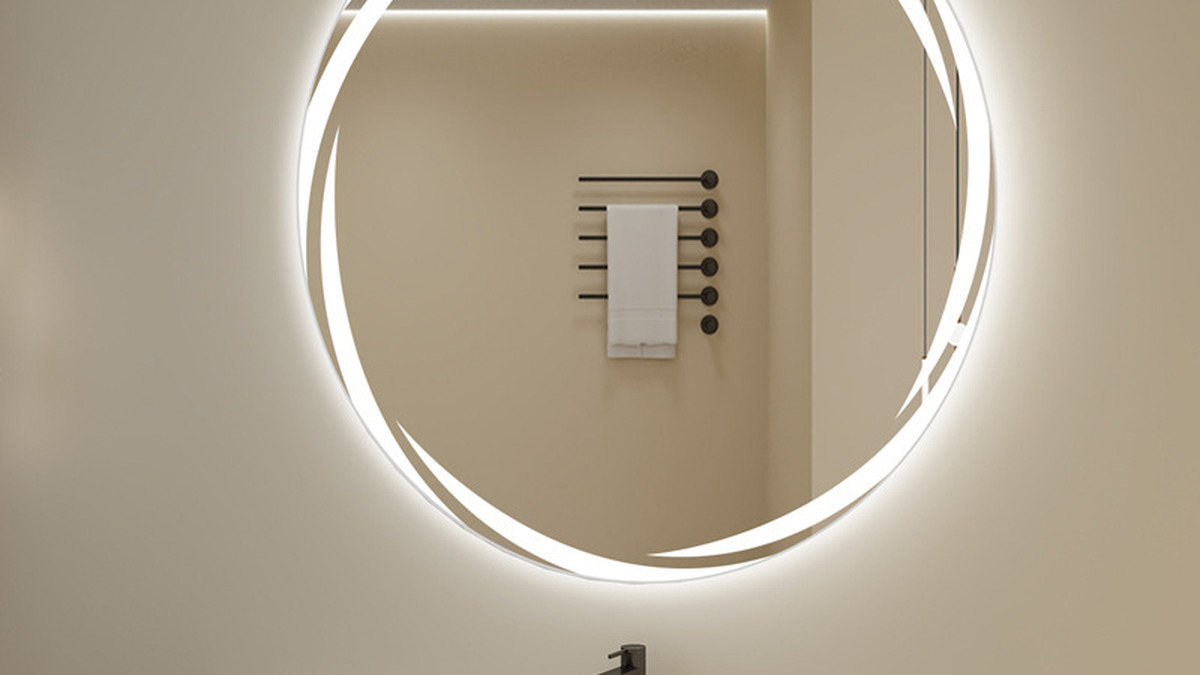
Put the sample on a table and the first impression is simple: mirror, light and one or two touch icons. The order behind it is less simple. Glass thickness, LED strip, driver, colour sequence, demister, wall hardware and carton all belong to the product. If one of those details changes, the same front view can hide a different build.
On Kingwin’s LED bathroom mirror page, several possible builds share one listing. Shape and size sit beside lighting choices, extra functions and two packing routes. It also names several certification and factory credentials. Treat that page as a menu, then write the chosen combination on the quotation. The sample on the approval table should match those choices.
The Product Range Behind One Listing
The page shows rectangular, round, pill and irregular versions. Its round examples run from 40 to 80 cm in diameter. For the reflective part, it lists silver or aluminium mirror glass in 3, 4 and 5 mm thicknesses. Gold, black and white frames are shown as available colours, with customization also mentioned. Wall mounting is the listed installation method.
Those entries are alternatives. They should not be read as one mirror carrying every material and size at once. A clear quotation names the chosen shape, visible size, glass, frame treatment and mounting arrangement. It also gives the item a model or drawing number. That small discipline prevents a catalog description from taking the place of the actual order.
Lighting and Touch Functions
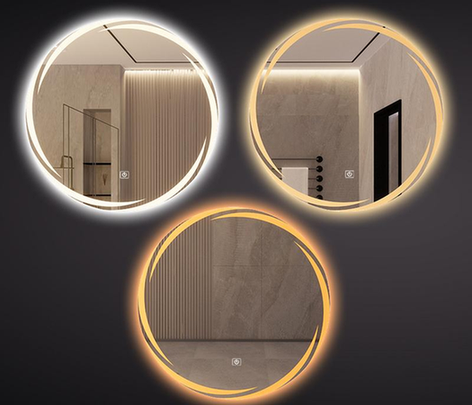
Three light buttons or steps are expected from the listing: warm at 3000 K, natural at 4000 K and white at 6000 K. It also shows dimming and touch operation. The LED row names both 2835 and 5050 SMD choices, with CRI above 80. Note which strip is inside the sample and pair that note with the driver label.
At sample review, use the mirror as a customer would. Tap through the colours, slide the light from bright to low, and cycle the power. Write the sequence beside the sample number. The result is not merely “light works.” It is a record of which build produced the approved colour sequence, brightness range and touch response.
Demister Clock and Display Choices
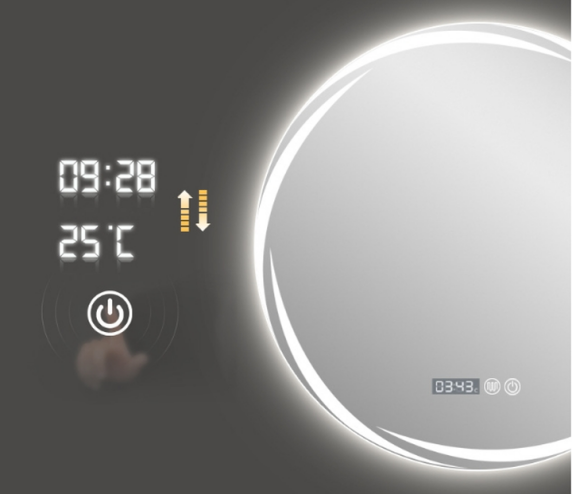
The demister is described as a touch-operated function. Clock, time and temperature displays are listed as optional. A basic retail mirror may omit the display; a hotel program may ask for the same icon position and operating sequence across several dimensions. Either arrangement can make sense. They simply need different item records.
The online hardware entry is one set of screws and plugs. Before packing, compare that set and the instruction sheet with the wall assumptions and sales market on the order. They are part of the packed set, while the final fixing decision remains with the installer who can see the wall construction.
What the Factory and Buyer Can Test
Use a sample built as closely as possible to the quoted item. Give it a number, photograph every readable label and place the drawing in the same approval folder. That trail matters when the bulk goods arrive months later.
Function and Appearance
Run all three light modes if they are included. Try the full dimming travel, each touch key and the demister. Let the mirror run, then make a second pass over the controls. For a clock or temperature option, set the display and step back to the normal viewing point. The supply, plug and controller used during approval should be recorded rather than left to memory.
The unlit mirror deserves equal attention. Look along the reflection, glass edges and visible backing. Record the outside measurements together with the centre-to-centre distance of the mounts. Check that control graphics sit where the drawing puts them. A signed sample can carry a short note about acceptable appearance; photographs alone rarely show a slight edge issue or a wrong hole position.
Packing and Shipment Evidence
Kingwin lists display packing for a store and mailbox packing for online sales. Store stock may reach its shelf on a pallet; an online order can pass through a parcel network. Pack approval therefore uses the finished mirror with its cable, hardware and printed sheets already in the box. The carton code and internal protection can then be written into the order.
The shipment record should point back to that configuration. Item number, order number, inspected quantity, checks performed and results are enough to make the report traceable. A loose “passed” stamp, without a model or date, says very little about the goods in front of the receiving team.
Reading the Certification Information Correctly
The product listing names CE, UL, SAA, Sedex, BSCI and RoHS. Another company page shows ISO 9001, ISO 14000, FSC, BSCI, Sedex and HIGG. They appear in one group online, yet each document has its own purpose and boundary. One may concern material traceability, another factory conditions, and another a management system.
Ask for the Document Not Only the Name
The public certification page is a useful place to begin. For the order file, obtain the current copy and read it. Read the name of the holder and the site first. Then check the issuer, number, dates, standard and product scope, including any model reference.
BSCI and Sedex information, for instance, cannot be used as an electrical approval for the mirror. A report covering one driver or plug does not automatically follow another part into production. If an electrical component changes after approval, check whether the related declaration, report and label remain suitable for the market.
Use the Supported Wording
This matters when product-page text moves into a retailer’s catalog. “Factory audited” and “product certified” are different statements. So are a material claim and certification of the finished electrical product. Marketing wording should follow the document supplied for the selected model, not the longest list visible on the website.
Qingdao Yinlongfei and the Kingwin Range
Qingdao Yinlongfei Handicraft Co Ltd identifies mirrors and framed mirrors among its home-decoration lines. The profile dates Yinlongfei to the early 1990s and says it was re-established in 2003. It gives a factory area of 10,000 square metres. OEM and ODM service, an R and D team and sales in over 40 countries are also mentioned there.
This is background on the supplier rather than a specification for any one mirror. During development, put the drawing number on the sample tag. Repeat the item number on the component list, carton record and compliance file. Later changes will show up on paper rather than survive only as a phone note.
Other shapes and functions appear in the bathroom mirror range. When asking for a project quotation through the contact page, include the market, quantity, dimensions, glass choice, light functions, packing route and documents needed. That gives the factory a defined starting point.
Conclusion
The Kingwin listing brings together mirror glass, three-colour lighting, dimming, touch control, demister and optional displays. Purchasing can release the item once the choices are fixed for one model. The test note, packing record and compliance papers then point to that same build all the way to shipment.
Common Buyer Questions
1 Which details belong in the LED mirror specification
Record the model and dimensions first, followed by the glass, lighting and driver. Add the touch and demister functions, any display, mounting set, electrical connection, labels, pack and sales market.
2 Are all functions on the webpage standard
No. The page presents several shapes, materials and optional functions. The quotation and approved drawing should show which ones belong to the ordered item.
3 What belongs in the sample record
Keep the sample number, drawing, component labels, dimensions, control sequence, test conditions, appearance notes, hardware, pack and dated approval.
4 Do factory audits replace product compliance documents
No. Audit, management-system, material and product documents have different scopes. Check the actual document against the selected model and destination market.