An approved mirror sample settles the appearance of one piece. What happens when that design becomes a wholesale order? At Kingwin Decor, our wood-framed, metal-framed and illuminated mirrors involve different production decisions, from frame construction to the functions fitted to an LED model. Our OEM/ODM service helps develop those details before production. The connection depends on defining the product clearly enough to make and inspect it.
Manufacturing choices begin with the mirror construction
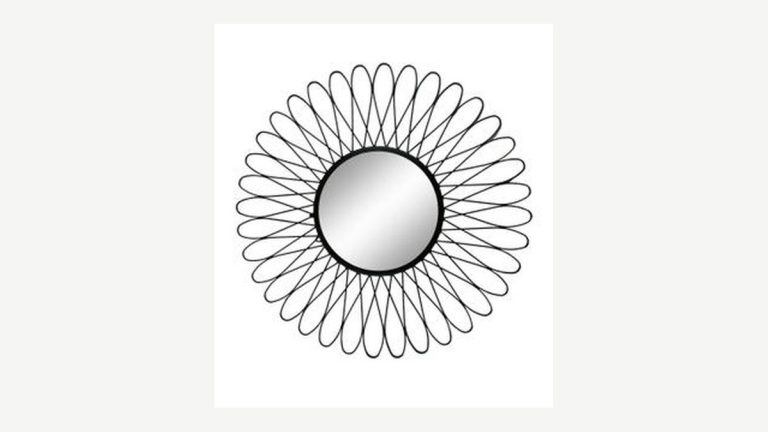
The frame specification tells an inspector which material and finish belong on the mirror, down to the joints where frame sections meet. With an illuminated design, the inspection also has to address the electrical parts and what happens when the mirror is switched on. We offer both types, but their specifications need separate treatment. A feature available on one design should never become an assumption about the whole collection.
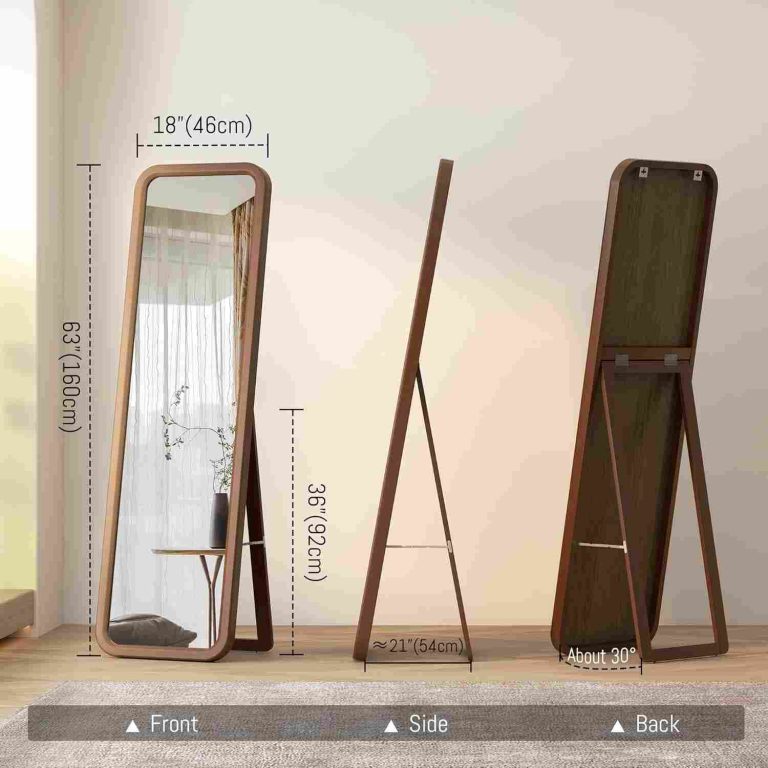
Our WM3518 wood-framed model illustrates the level of detail behind a finished mirror. WM3518 measures 400 mm wide and 1600 mm high across the frame. Inside that frame is a 370 × 1570 mm mirror. MDF veneer is specified for the frame, and the silver mirror glass is 3 mm thick.
WM3518 therefore has two sizes to carry into a product brief. For a product listing, the outer measurement answers “Will it fit here?” The inner measurement tells your customer how much of that space is reflective glass.
The frame-to-glass proportion is visible even before you examine a large wall mirror up close. A wider surround leaves less reflective area. Your design brief should identify both. For several sizes intended to sit together in a retail range, record the frame depth and finish as well as how each size will hang.
OEM and ODM turn a design direction into a defined product
Our R&D team supports both OEM and ODM projects. If you bring an OEM specification, we work from the mirror you have defined. Resolve open details during development. An ODM discussion can begin with our design range and develop an agreed variation. The useful distinction is who supplies the design direction and which details still need development.
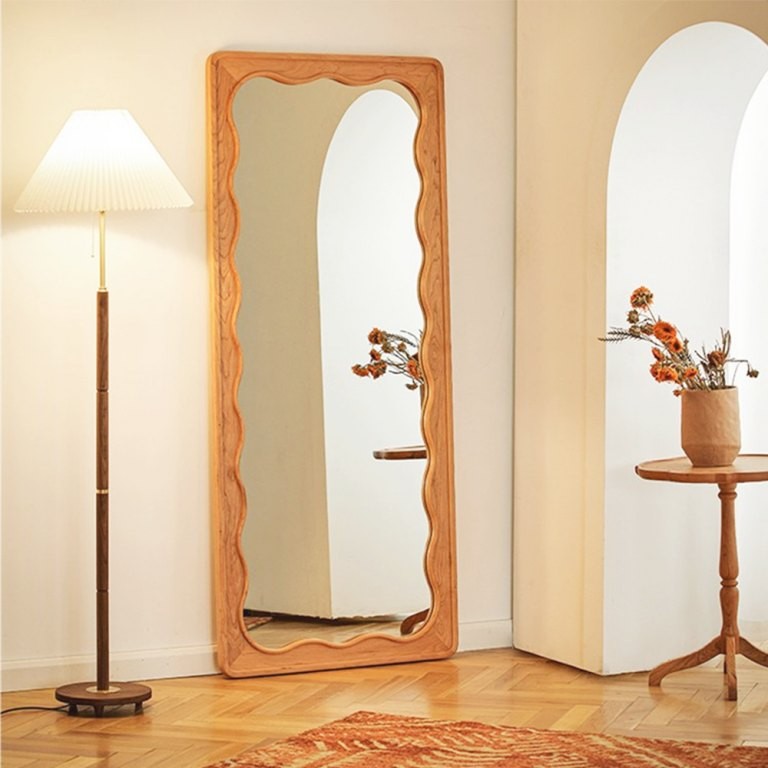
For an ODM discussion, a wood frame mirror can give your team a shape to work from. Keep that reference alongside the proposed construction. If the brief keeps the outline but changes the material or mounting method, write down those changes beside the reference.
For a logo or text request, show us the artwork at its intended position on the mirror. We assess those details for the quotation. There is a charge for the sample and its freight. Once you place an order, the sample fee is returned. Check the sample terms for your selected design.
The sample gives your team something concrete to review. Check the approved appearance alongside the written specification, including dimensions and finish. Where a collection uses several variants, make clear which sample represents each variant. One approved color does not settle the appearance of another finish.
Lighting options need their own specification
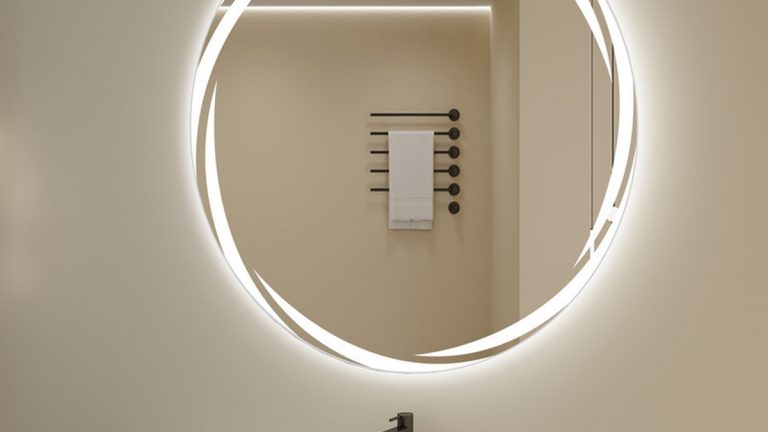
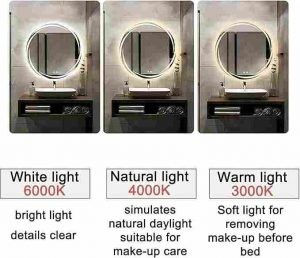
A bathroom mirror with lights requires decisions beyond the frame. This range offers three color temperatures: 3000 K, 4000 K or 6000 K. You can choose a gold, black or white frame, or discuss a custom color with our team. Those choices describe this range only. Leave those electrical choices out of the brief for a non-illuminated design.
A 3000 K option tells you the light color, but the number does not tell you how bright the mirror will be. Specify the controls and operating functions separately. Confirm dimming or defogger requirements before sample approval. An illuminated sample should be reviewed while operating, as well as when switched off.
Quality control follows the product through production
We inspect during production, inspect 100% of the mirrors before packing, and carry out final inspection. In-line checks take place while the work can still be examined in progress. Before packing, each finished mirror is inspected. Final inspection adds an order-level review. Specify checks for the frame finish and the operating light separately.
Our internal testing equipment supports several checks relevant to mirrors. The test needs to match the construction and intended use. A list of available equipment alone does not establish a product’s test result.
| Available check | Product question it helps examine |
| Salt spray testing | How does the tested finish respond under the specified exposure? |
| Adhesive firmness testing | Does the bonded assembly meet the agreed attachment requirement? |
| Suspension and load-bearing testing | Does the tested mounting arrangement meet the specified load conditions? |
| Drop testing | How does the tested packed product respond to the selected drop conditions? |
| Light-box operation testing | Do the selected lighting functions operate as required? |
For salt spray testing, ask how long the exposure lasted and what counted as an acceptable result. Record those conditions with the result. A load test needs the tested arrangement and load.
We can discuss mirror inspection reports for your requirements, but a report should identify the model and configuration it actually covers. Avoid extending one result to an untested variant.
Audit records and product evidence answer different questions
Our factory audit references include BSCI, Sedex and HIGG. These references belong in the assessment of factory practices. Product performance and market compliance need their own applicable evidence. A factory audit should never be presented as proof that an electrical mirror meets every requirement in its destination market.
Wood-material claims also require a defined scope. When your range requires an FSC claim, confirm the applicable material and supporting documentation with our team. Likewise, electrical compliance discussions should identify the exact mirror, components and intended market. Certificate names without those connections leave too much unanswered.
A mirror program needs a shared production reference
The strongest link between design and delivery is a clearly defined product: agreed construction, an approved sample, relevant inspection requirements and suitable packaging. Our options include display packing for stores and mailbox packing for online sales on specified models. Confirm the packing arrangement for your selected mirror and distribution route.
Bring your design brief and destination-market requirements to our team so we can discuss a suitable Kingwin mirror configuration and the evidence needed for your program.
FAQ
Is Kingwin Decor a factory or a trading agent?
We manufacture mirrors. You can discuss the selected mirror directly with our team, including its frame, glass, customization and required inspections.
Can we request a logo on a mirror?
Yes. Mark the intended position on the design and supply the artwork with your request. We need that detail to assess the customization and prepare its quotation.
What are the minimum order quantities?
Depending on the type of mirror, our general MOQ guidance runs from 200 to 500 pieces. Treat that as planning guidance until the selected mirror and any customization have been quoted.
Does every mirror include LED lighting?
No. Our range includes non-illuminated mirrors as well as LED models. Lighting functions must be confirmed for the specific configuration.
Does an internal test replace a market compliance report?
No. Internal testing supports product evaluation. The evidence required for your market must be checked against the applicable product and requirements.