
Small movement beside the upper hinge travels down the long easel leg and ends as a noticeable wobble. A low pad, a hinge leaf sliding on the frame, or a pivot with extra clearance may therefore produce a similar sensation at floor level. Each follows its own path: balance changes at the feet, clamp is lost at the mounting face, or two pivot parts move farther apart. The part that starts moving first tells them apart.
Which Part Moves First: a Foot, the Frame, or the Stand?
Place the secured mirror at its everyday opening angle. Light pressure at a bottom corner then exposes whether one foot loses contact or the rear mechanism shifts while every foot remains down. That distinction keeps a balance problem from being misread as worn hardware.
How does the floor contact change as the frame moves?
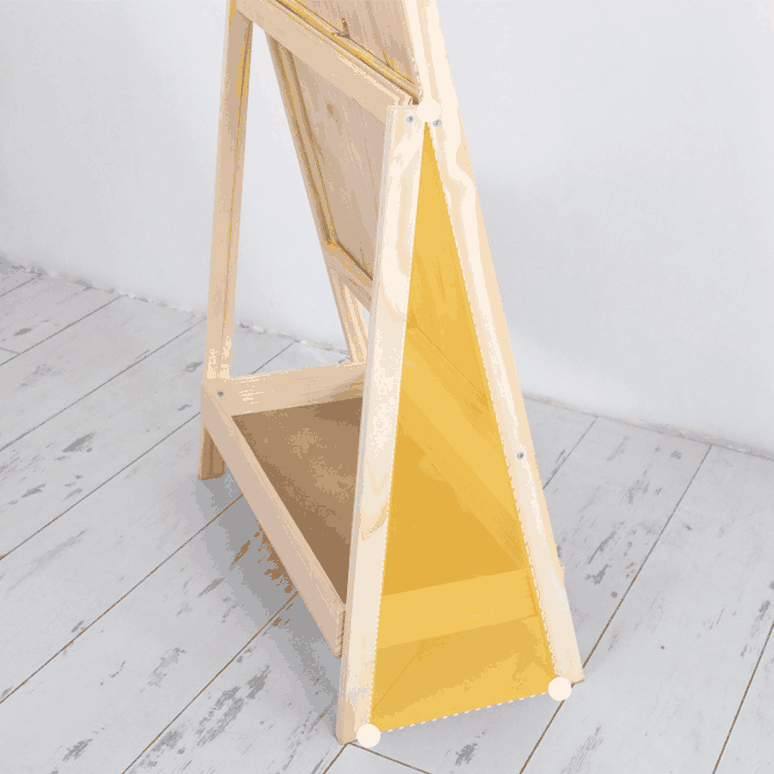
When the whole assembly rocks, watch the feet rather than the hinge. One foot may lift as the opposite corner is pressed. Loss or compression of a pad lowers its corner. A sloping surface or slight frame twist can make the mirror roll from one contact point to another. What looks like movement at the hinge is then the entire mirror pivoting on a different foot.
Opening angle changes the weight distribution too. If the stop falls short of its normal position, one floor contact may unload. When the frame becomes steady at the intended angle, the original wobble came from support geometry or contact, not clearance newly created inside the hinge.
Where does joint play appear when every foot remains down?
Stable floor contact shifts attention to the upper connections. Seen from the side, a hinge leaf can be compared with the frame while the arm is compared with its pivot. Sliding between leaf and frame belongs to the mounting joint. Side movement of the arm with the leaf motionless belongs nearer the pivot.
The support foot may sweep through a broad arc even though the upper slip is slight. Watching the bracket instead of the foot makes the first relative motion easier to place.
Where Do the First Rub Marks Appear?
Every opening changes the direction of force at the upper joint. Loss of clamp leaves traces at the bracket face; added pivot clearance leaves them around the pin. Their location matters more than the total wobble measured at the bottom.
What remains after a bracket has slipped?
A narrow bright strip along the hinge leaf, a second outline in the finish, or a gap opening beneath one edge indicates relative movement at the mounting face. A witness mark crossing the screw and bracket adds another clue: misalignment of the mark means the screw rotated as well.
A screw head may remain flush even as the grip beneath it falls. The leaf can creep first. In another joint, the screw stays aligned and only the leaf shifts. Reading the screw, leaf edge, and old finish line together shows which surfaces changed position.
How does a wood receiving hole fail differently from a pivot?
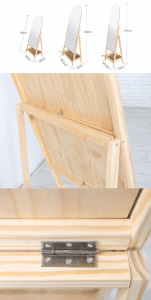
A wood screw depends on intact material pressing against its threads. Once that material crushes or breaks away, turning the screw produces little resistance and may push fine debris out of the hole. Another turn removes still more material.
Pivot wear instead tends to polish a ring around the pin, move a washer off centre, or brighten one bearing face. Polish on only one side may come from an arm entering the joint at an angle. A stop that must be forced can impose that sideways load at every opening. The intended drawing or approved sample decides whether the apparent asymmetry is part of the design or a real alignment error.
Does Routine Opening Increase the Same Gap?
Normal opening is useful here because it returns load to the same suspect surfaces. A test becomes less informative when its aim is merely to accumulate cycles; what matters is whether the first gap or rub mark develops further.
Which visible change links folding with the cause?
On the same floor and through the normal opening range, the joint can be revisited between groups of movements. If rotation at the screw is followed by a larger gap under the leaf, the folding motion is progressively reducing clamp. If the leaf and its fasteners stay fixed while sideways clearance grows at the pin, the pivot remains the stronger explanation.
Force beyond the stop describes a different event. Damage appearing only after that extra travel belongs to the opening method or stop geometry, not to routine folding. Transport impact is another separate input; mixing it into the sequence makes the new mark impossible to attribute.
When has the original evidence been overtaken by damage?
Once a wood hole strips, a stop bends, or the mirror loses safe support, later cycling spreads force into neighbouring parts. New gaps and marks may then be consequences rather than causes. That is the point to preserve the assembly as found.
Pass-fail numbers must come from the product specification or an agreed validation plan. Without them, the observation can still establish the order of movement and whether normal folding increases it.
Which Part Must Still Carry Load After the Repair?
Clamp and bearing support have to come from sound material. The same screwdriver movement may restore tension in serviceable metal threads yet tear away the remaining grip in a damaged wood hole.
When is existing hardware still usable?
Sound metal threads can accept the assembly torque or retention method specified for that construction. A screw with no reliable grip in wood cannot. Its receiving hole and surrounding frame need a construction decision; a compound for metal threads does not rebuild wood that has broken away.
Clearance around the pin makes the pin, washer, bushing, and bearing faces relevant. Leaf slip makes the frame mounting relevant. Unequal opening makes the stop and bracket alignment relevant. Repeating the earlier movement after repair reveals whether the original path is gone, rather than simply masked by temporary stiffness.
How can the affected scope follow the hardware rather than the symptom name?
Mirrors with different rear supports should not be grouped because all were reported as “loose.” The useful grouping is the actual bracket, pivot, frame material, and shipment reference. A wide rear photograph establishes those parts; the close view then captures the first surface that slides.
Floor-mirror and full-length-mirror ranges include leaning and wall-mounted designs too. A correction developed for an easel pivot cannot logically apply to a model that has no such pivot. The scope expands only when the hardware and the observed path match.
Explore Floor Mirror Options from Qingdao Yinlongfei
For buyers sourcing free-standing floor mirrors, frame design and rear support construction are important considerations. Qingdao Yinlongfei Handicraft offers mirrors and home-decoration products for different interior settings. Its Arched Wood Easel Standing Floor Mirror features a wood and engineered-wood construction, a rear support, and anti-tip hardware. Buyers looking for similar floor mirror designs can explore the product and contact the company to discuss their sourcing requirements.
Conclusion
Movement at the support foot is magnified evidence, not a diagnosis. A lifting foot traces back to balance and contact. A moving leaf traces back to its mounting face. Side clearance beside a fixed leaf traces back to the pivot, while a freely turning wood screw traces back to its receiving hole. Watching that joint during ordinary opening reveals whether the suspected condition grows and whether the repair changes its course.
FAQs
How can the screw feel tight while movement remains?
Tightness at the head says little about a different interface. The remaining play may lie at the pivot or in loosened material around the hole.
Will thread-locking adhesive rebuild a wood screw hole?
No. Lost wood fibre and altered hole shape require a construction remedy, not a metal-thread compound.
Which camera angle reveals the source of play?
Frame, hinge leaf, pivot, and the upper support should appear together so the first relative movement is visible.
Does one loose mirror establish a batch problem?
It establishes a reason to examine related units. A wider finding depends on shared construction, shipment information, and the same failure path.