

Two decorative wall mirrors can carry similar factory prices yet arrive at a retailer’s warehouse with very different costs. The difference may have little to do with the supplier’s quoted price. A deep wooden frame occupies more shipping space than a narrow metal profile, while an unusually shaped mirror may need a larger carton to protect its exposed edges. Importers also have to account for freight, customs charges, delivery arrangements, and products that cannot be sold after transportation. When comparing wholesale wall mirrors, the useful figure is therefore the cost of each sellable unit after the shipment reaches its destination. Understanding how the mirror’s construction affects that figure gives purchasing teams a clearer basis for deciding which designs belong in their retail range.
Why Can Similar Wholesale Wall Mirrors Have Different Delivered Costs?
A buyer comparing two wall mirrors may initially see the same glass dimensions, a similar frame color, and only a small difference in the quoted price. Once the finished products are measured and packed, the commercial picture can change.
Frame Construction Changes the Shipping Profile
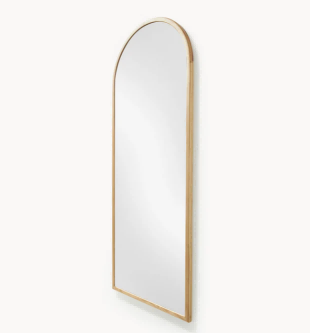
A decorative wooden frame may extend farther beyond the reflective surface than a narrow metal profile. Even when both mirrors use glass of identical dimensions, their packed sizes can differ considerably.
This matters because international transportation costs can depend on the space occupied by a shipment as well as its weight.
A retailer considering several styles from a manufacturer’s wall décor mirror collection should request the finished dimensions and external carton dimensions separately.
A product image may communicate the design perfectly while revealing very little about the space required to transport it.
A Lower Factory Price May Conceal a Different Construction
Price comparisons are also misleading when suppliers quote different glass thicknesses, frame materials, or backing structures.
A cheaper mirror is not necessarily a better purchasing opportunity if the specification differs from the approved design.
Before comparing delivered costs, the buyer needs to establish whether the quotations describe equivalent products. Where construction differences are intentional, they should remain visible in the comparison rather than being treated as unexplained price advantages.
How Do Mirror Dimensions and Packaging Affect Freight Costs?
For international orders, the characteristics of the packed mirror matter more than the dimensions printed in a product catalogue.
A mirror measuring 80 cm across will occupy additional space once its frame and protective packaging are included. An irregular outline or projecting decorative detail may increase that space further.
Packed Dimensions Determine the Space Required
Freight calculations vary by transport mode and service, so a purchasing team needs accurate carton information before requesting a shipping estimate.
The supplier’s packing details should identify external dimensions, gross weight, carton quantity, and the proposed loading arrangement.
A large decorative frame may create unused space around the mirror inside its carton. Repeating that space across hundreds of units can affect the total shipping volume.
Buyers reviewing different designs in the manufacturer’s mirror product range can account for these differences before deciding which products fit their intended wholesale program.

Smaller Cartons Are Not Automatically More Economical
A compact carton may reduce shipping volume, but insufficient protection can expose the reflective glass or frame to damage.
The most useful comparison is between packaging arrangements that provide appropriate protection for the actual product and delivery route.
A retailer supplying individual online orders may require a different packing arrangement from an importer receiving mirrors for distribution to physical stores.
Trying to minimize carton dimensions without considering the final delivery process can shift costs from freight to damaged inventory.
Which Import Expenses Belong in a Wall Mirror Landed-Cost Calculation?
A factory quotation does not necessarily include transportation to the buyer’s warehouse. The charges that remain payable depend on the agreed delivery terms and the route used for importing the mirrors.
Two offers cannot be compared accurately until those differences are understood.
Delivery Terms Change the Scope of Each Quotation
An EXW quotation and an FOB quotation cover different responsibilities. A CIF quotation may include further transportation costs, but it does not necessarily represent the complete cost of delivering the goods to the buyer’s warehouse.
The named place and agreed Incoterms version should be recorded alongside the price.
Purchasing teams can then work with their freight forwarder to calculate the additional charges required to reach a common delivery point.
Otherwise, a supplier may appear cheaper simply because its quotation excludes expenses included in another offer.
Import Charges Must Reflect the Actual Destination
Customs duties, taxes, port charges, clearance fees, and inland transportation may affect the final cost.
Their treatment depends on the destination, applicable classification, delivery arrangement, and relevant import rules. A general percentage should not be applied indiscriminately to every mirror shipment.
Importers also need to distinguish recoverable taxes from expenses that remain part of their actual purchasing cost.
For quotations involving different delivery arrangements, accurate local cost information is more useful than a broad estimate copied from an earlier shipment.
How Does Mirror Breakage Affect the Cost per Sellable Unit?
A shipment’s commercial value is determined by the mirrors available for sale after receiving, not simply by the quantity stated on the purchase order.
A damaged frame, broken glass panel, or other unacceptable condition may prevent an imported mirror from entering the retailer’s inventory.
Receiving Losses Change the Original Calculation
Consider an illustrative order of 500 wall mirrors with a total relevant landed cost of $20,000.
If every unit is sellable, the calculated cost is $40 per mirror. If 20 units are unsellable, that same amount is allocated across 480 units, increasing the calculated cost to approximately $41.67 per sellable mirror.
Actual costs would also need to reflect any insurance recovery, supplier credit, or additional handling expenses.
The example demonstrates why a small apparent factory-price advantage may become less meaningful after receiving.
It is not a claim about any manufacturer’s actual damage rate.
Historical Receiving Records Provide Better Evidence
Importers with established mirror programs can examine previous shipments of comparable sizes, frame constructions, and delivery routes.
Those records provide a more relevant basis for estimating potential losses than an arbitrary percentage.
A new design with an unusual frame or much larger glass surface may still require separate evaluation because its handling characteristics differ from earlier products.
Receiving results should therefore be connected to the actual mirror construction rather than applied uniformly across an entire catalogue.
How Should Buyers Compare Competing Wall Mirror Offers?
A useful comparison brings the product specification, shipment characteristics, and delivery expenses into one purchasing decision without allowing logistics details to overshadow the mirror itself.
The purpose is to understand which design fits the retailer’s commercial requirements after all relevant costs have been considered.
Compare Products on an Equivalent Specification
Glass dimensions, thickness, frame material, finish, backing, and mounting configuration should be established before final price comparisons begin.
If one supplier offers a different construction, that variation needs to be evaluated separately.
The purchasing team can then add the relevant freight estimate, import expenses, and receiving-cost assumptions to each offer.
This makes it easier to identify whether a price difference comes from the product, the transportation arrangement, or the quality of the quotation.
Match the Calculation to the Sales Channel
A wholesaler receiving an entire shipment at one warehouse faces different downstream costs from an online retailer delivering mirrors individually.
The same mirror may therefore have different commercial implications for those buyers.
When dimensions, construction, or packing details remain unclear, the manufacturer’s contact page provides a way to confirm the proposed specification before requesting final transportation estimates.
The comparison should ultimately reflect the buyer’s actual route to market.
Need Help Matching Wall Mirror Specifications to Your Wholesale Requirements?
Once a retailer has identified suitable wall mirror designs, the next purchasing task is confirming the construction and shipment details needed for an accurate quotation. Qingdao Yinlongfei Handicraft Co., Ltd. works with overseas buyers on mirror manufacturing and OEM/ODM development involving customized dimensions, frame materials, finishes, and packing requirements. Buyers can use the manufacturer’s wall mirror product range as a reference when discussing different construction options. The final inquiry should specify the intended design, quantity, sales channel, delivery terms, and required packing information so that the quotation reflects the product the buyer actually intends to import.
Conclusion
The landed cost of a wholesale wall mirror is shaped by more than the factory quotation. Its dimensions, frame construction, packed volume, delivery terms, import charges, and condition on arrival all influence the amount ultimately paid per sellable unit. Importers can make a more useful comparison by establishing equivalent product specifications first and then calculating the costs associated with their own distribution route. This keeps the purchasing decision focused on the commercial suitability of the mirror rather than selecting a quotation that only appears less expensive because important expenses have been excluded.
FAQs
1. What Is Included in the Landed Cost of a Wholesale Wall Mirror?
Depending on the agreed delivery terms and accounting treatment, it may include the product price, freight, insurance, customs duties, clearance charges, and transportation to the specified destination.
2. Can Wall Mirrors With Identical Glass Dimensions Have Different Freight Costs?
Yes. Frame depth, overall dimensions, protective packaging, gross weight, and carton configuration may differ even when the reflective glass is the same size.
3. Should Buyers Compare EXW and FOB Quotations Directly?
No. Their cost and responsibility scopes differ. Buyers should establish a common delivery basis before comparing the complete purchasing cost.
4. How Does Breakage Affect the Cost per Sellable Mirror?
Unsellable units reduce the quantity available for sale, potentially increasing the effective cost of each remaining mirror after relevant costs and recoveries are accounted for.
5. Which Details Should Buyers Request Before Calculating Landed Cost?
Request the approved product specification, unit price, packed dimensions, gross weight, carton quantity, delivery terms, and information needed to obtain accurate freight and import-cost estimates.