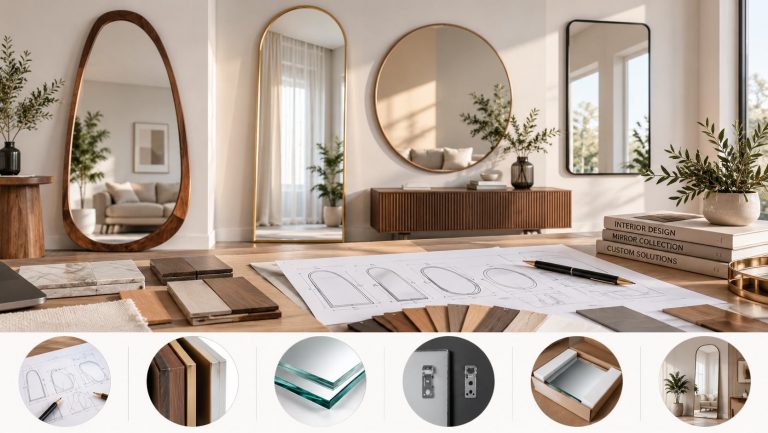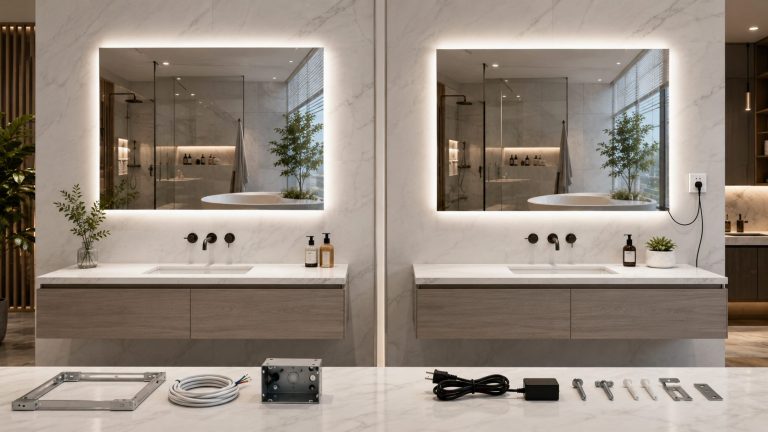
There is an ever-increasing demand for free distortion full-length mirror, which are required in the design of residential and commercial spaces. While full length mirrors are widely used for their optical quality, strength and style, the quality of the images reflected in them depends above all on the thickness of the glass and the quality of the backing. If a mirror is of a suitable thickness and has a quality back then it will accurately reflect all images without distorting any lines. However, the glass thickness and the quality of the backing also have a significant bearing on the durability and the overall stability of the mirror. This article examines the key scientific and production factors which determine the quality of full length mirrors, that will be of interest to those in the fields of materials science, design engineering and production.
What Factors Cause Distortion in Full-Length Mirrors?
Before evaluating glass thickness or backing materials, it is essential to identify what causes reflection distortion in the first place.
The Role of Glass Flatness and Surface Uniformity
Distortion in mirrors typically is caused by very small defects in the glass production process. As glass cools unevenly or is subjected to unequal roller pressure while it is still in a molten state on the float line, the glass can become warped. Warping of this nature can be measured in mere microns and be so slight that it is not apparent when viewing a small mirror. However, as a mirror is increased in size, such very slight curvature becomes apparent when viewed as a large mirror. In the production of professional quality full length mirrors, flatness is a critical parameter and is normally measured as ±0.1 mm/m. This small dimension becomes more than amplifies very slight curvature found in normal glass production as the size of the mirror increases. Thus, control of the processing of float glass, particularly temperature, is critical to produce a very optically perfect mirror. The annealing of the glass must also be very uniform to prevent distortion in the finished mirror.
Impact of Installation and Mounting Techniques
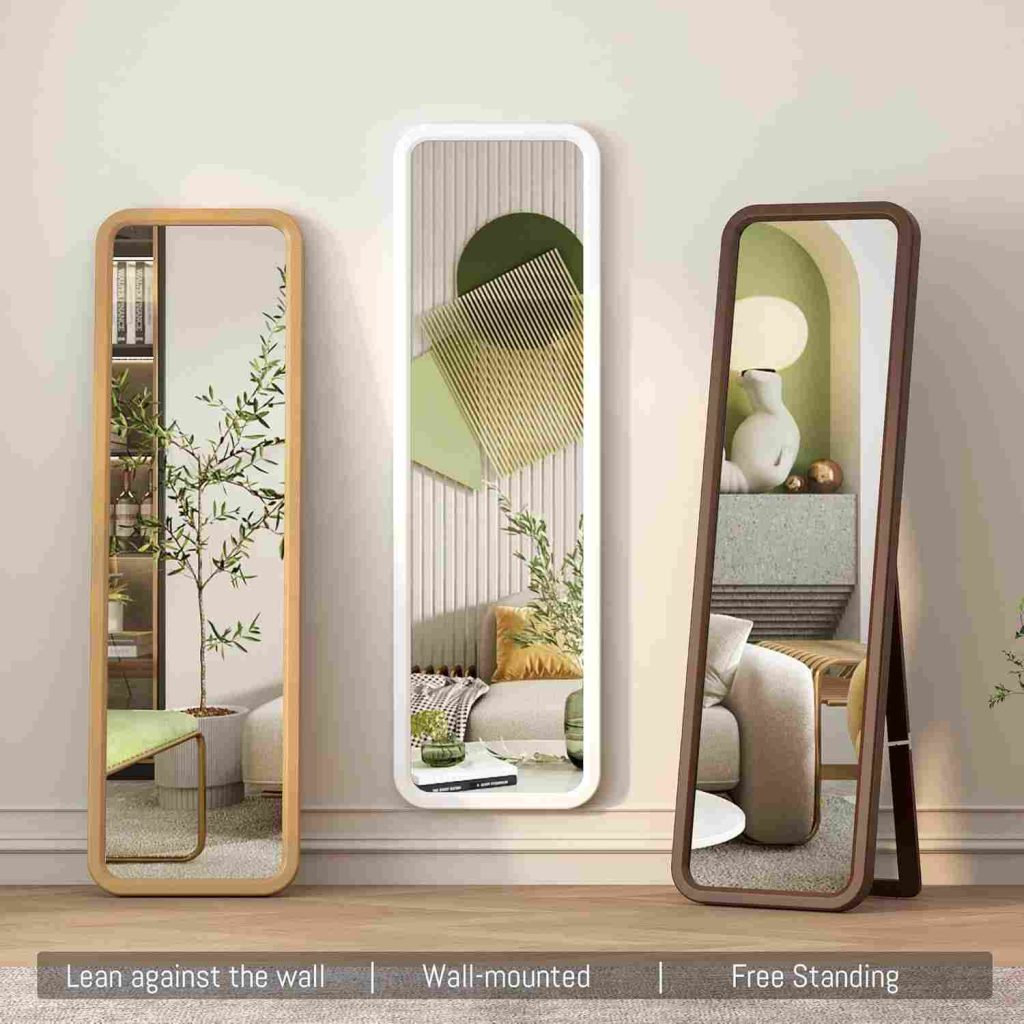
A perfectly manufactured distortion free mirror can also cause irregular reflections when installed incorrectly. An uneven wall or an unsuitable frame can cause local stress to the mirror, which over time causes it to bend. To prevent this, mirrors should be mounted on a rigid backing support, such as an aluminum frame or a thick MDF panel. The wall must be aligned correctly using a laser level before the mirror is attached to the wall. Also the adhesive used for mounting the mirror must be applied uniformly to the surface of the glass to avoid any differential tension between the individual areas of the glass.
How Does Glass Thickness Affect Mirror Performance?
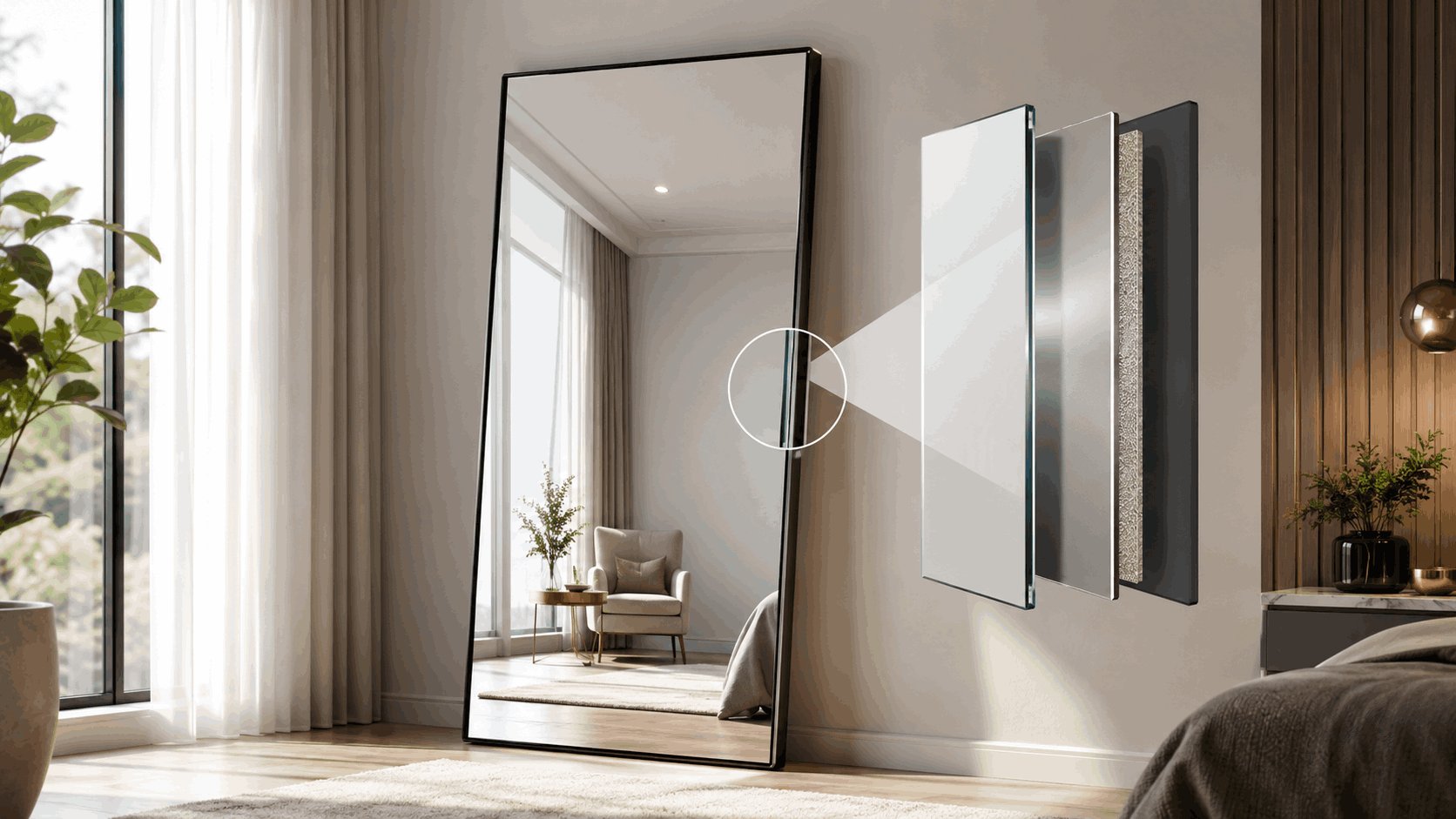
The thickness of the glass of a mirror is critical to its flatness, and the ability to hold its own form against its own weight, or external influences such as vibration, or even changes in temperature.
Correlation Between Thickness and Structural Stability
Common thicknesses for high quality full length mirrors include 3mm, 4mm, 5mm, and 6mm. Thicker glass inherently resists flexing because it has greater moment of inertia—a mechanical property defining resistance to bending stress. A 5mm panel provides an optimal balance between rigidity and manageable weight for most architectural applications. While thicker options like 6mm offer superior stability for oversized installations, they also increase total mass, which may complicate mounting logistics and raise costs due to higher material consumption. Conversely, thinner mirrors such as 3mm variants are lighter but more susceptible to deformation when subjected to minor pressure variations or uneven adhesion layers.
Optical Precision and Reflection Accuracy
The small amount of glass in a display is also thin, which means that it can bend slightly under the force of gravity or vibration. The amount of bend can result in a “funhouse” like distortion of straight lines on the display. To avoid such distortion it is crucial to control the thickness of the glass across the entire panel. The variation in thickness, even slight, can cause local change of the reflection angle which in turn can degrade the display’s image quality. Manufacturers of display panels use advanced polishing techniques to achieve uniform thickness and use laser scanning inspection systems to measure and verify the thickness before applying the reflective coating.
Why Does Mirror Backing Material Matter?
The backing of a mirror, whether it is made of wood, MDF or some other type of material, serves two key purposes. It provides protection to the mirror and in addition offers structural support. The choice of backing and its construction has a huge bearing on both the mirror’s durability and how well it will perform over time.
Protective Function of Backing Layers
Typical backings for mirrors are for example MDF boards for framed mirrors, PVC safety films for frameless mirrors and aluminum foil laminates for mirrors exposed to moisture. The backing protects the reflective coating, typically made of silver nitrate or even vacuum deposited aluminum, from oxidation by humidity and contamination by adhesives and paints. Without adequate backing, the coating can be damaged by corrosion, leading to a loss of reflectivity or even to dark spots, especially at the edges of the mirror where moisture has entered.
Contribution to Rigidity and Longevity
The mirror backing also provides additional strength and rigidity to the mirror, to prevent it from flexing in normal use, when mounted to a wall or to a furniture structure. In humid environments, such as bathrooms and fitness studios, moisture resistance becomes even more important. Here, a PVC backed mirror is superior to a fiberboard backed mirror. Not only is PVC a non porous surface, but it is also dimensionally stable in all temperatures, unlike a fiberboard backing. High quality manufacturers use multi layer composite backings. These are made up of a variety of polymer films, and also include a number of metallic foils. These allow the manufacturer to create a product that is not only strong and rigid, but also provides environmental sealing.
What Defines a High Quality Full-Length Mirror?
Measurable attributes of a product must correspond to the international manufacturing standards to be able to classify a product as premium-grade.
Material Selection Criteria for Premium Mirrors
Low-iron content glass is preferred because it eliminates greenish tint common in standard float glass, ensuring color-neutral reflections ideal for fashion retail spaces or photography studios. Reflective coatings should exhibit high spectral reflectivity—typically above 90%—and uniform deposition thickness across the surface. Edges must be precisely ground and sealed to prevent chipping during handling while maintaining geometric accuracy throughout production batches.
Design Considerations for Professional Applications
Quality full length mirrors are completely flush to surrounding architectural elements, including lighting or frames. They are designed to create a beautiful space and so incorporate no stress points. To increase perception of depth, designers use a back light of LED’s or have the mirror beveled to create an extremely optical accurate surface.
How to Choose a Distortion-Free Mirror for Different Settings?
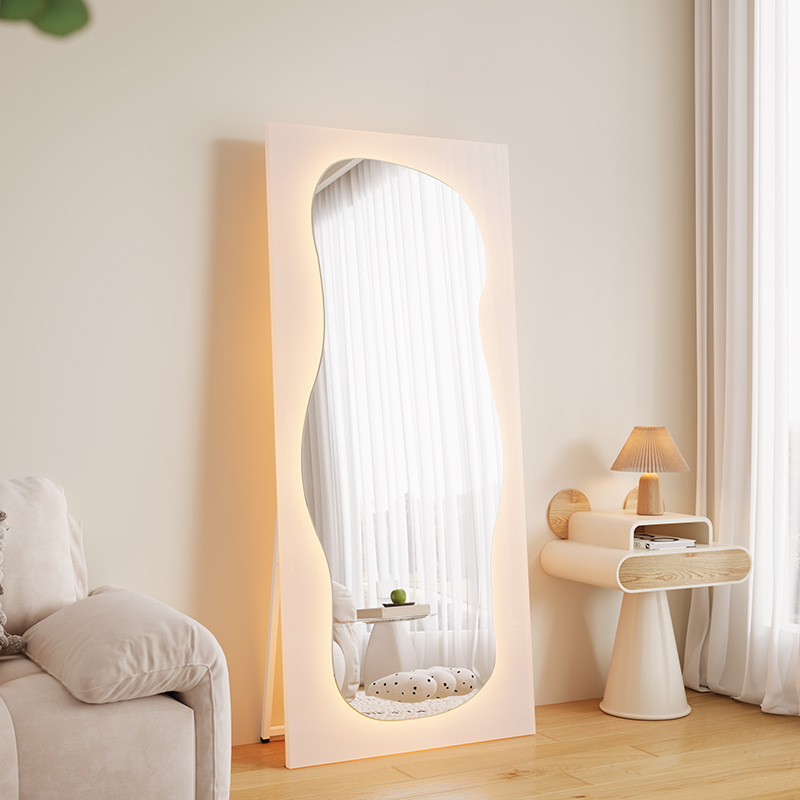
Choosing the correct distortion free mirror is a matter of matching the relevant specifications with your intended use.
Residential vs. Commercial Requirements
While appearance may take precedence over durability in private homes containing large frameless screens in dressing rooms or hallways, structural integrity is crucial. Retail fitting rooms require greater resistance to repeated contact and cleaning products. Using tempered safety glass that is protected by shatterproof films in retail spaces is the best way to fulfill public safety codes while maintaining transparency.
Evaluating Supplier Specifications Before Purchase
When purchasing optics, it is common practice for professionals to ask for a detailed technical data sheet. On such a sheet you will find information like the flatness tolerance of a lens (e.g. 0.2 mm/m), the refractive index uniformity (around 1.52 for F2 glass), the reflectance of the coating, the adhesion between the different backing layers and data from environmental tests that check for corrosion after exposing the optics to high levels of humidity in test cycles.
Why Qingdao Yinlongfei Handicraft Is a Reliable Full-Length Mirror Supplier
Qingdao Yinlongfei Handicraft is an experienced manufacturer specializing in producing high quality full length mirrors that are made for optimal optical performance and durability. The mirrors are made with advanced float-glass calibration technology to ensure minimal surface deviation and strict tolerance. The production lines are equipped with automated polishing units and multi-stage inspection process to guarantee thickness uniformity. Each of the distortion free mirrors is inspected for surface polish using interferometric analysis before the reflective coating is applied. The enhanced silvering protection is applied to the coating and it is covered with durable PVC film on the back. The PVC film is tested for aging under different conditions and it maintains the mirror’s clarity in different climates and environments. The mirrors are shipped worldwide to famous furniture brands, interior designers and contractors as well as design studios. The company provides custom made mirrors that meet international quality standards and delivers them on time.
Conclusion
The thickness of the glass of a full-length mirror determines the degree to which the mirror is resistant to deformation by external forces, while affecting the reflection accuracy. The backing of a mirror affects the long-term dimensional stability of the mirror by protecting the reflective layer against environmental influences. To guarantee a mirror to be free from distortion in the long run it is not only important to choose a suitable optical coating but also the corresponding backing configuration. The selection of suitable mirror backings enables to create mirror products that are not only optically perfect but also aesthetic pleasant and which can be used in private interiors as well as in commercial display areas.
FAQs
What is the recommended glass thickness for a distortion-free full-length mirror?
A thickness of 5mm or greater is generally preferred because it reduces flexing whilst remaining light enough to handle during installation.
How does backing material affect mirror clarity?
The backing material does not affect the reflection quality, but it has to be correct to stabilize the mirror and to prevent warping which can cause optical distortion.
Are all “high quality” mirrors automatically distortion-free?
No, even so-called “high quality” glazing products have only a certain tolerance for distortion in glass production and in subsequent processing and assembly.