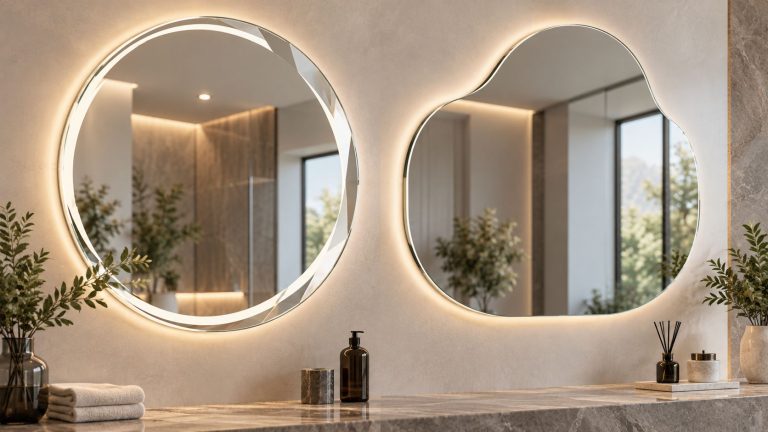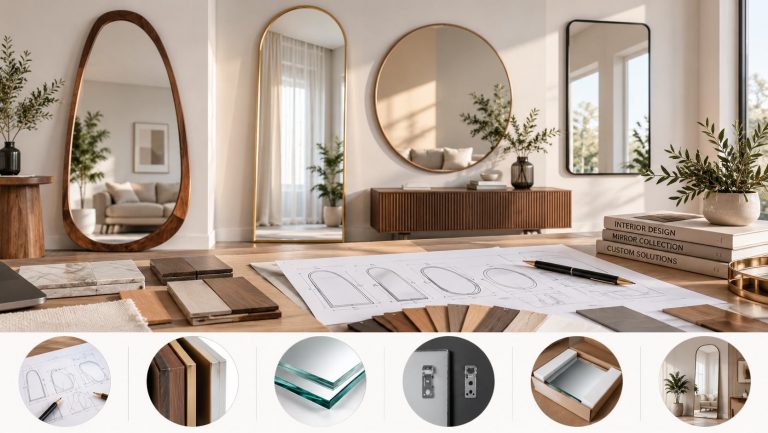
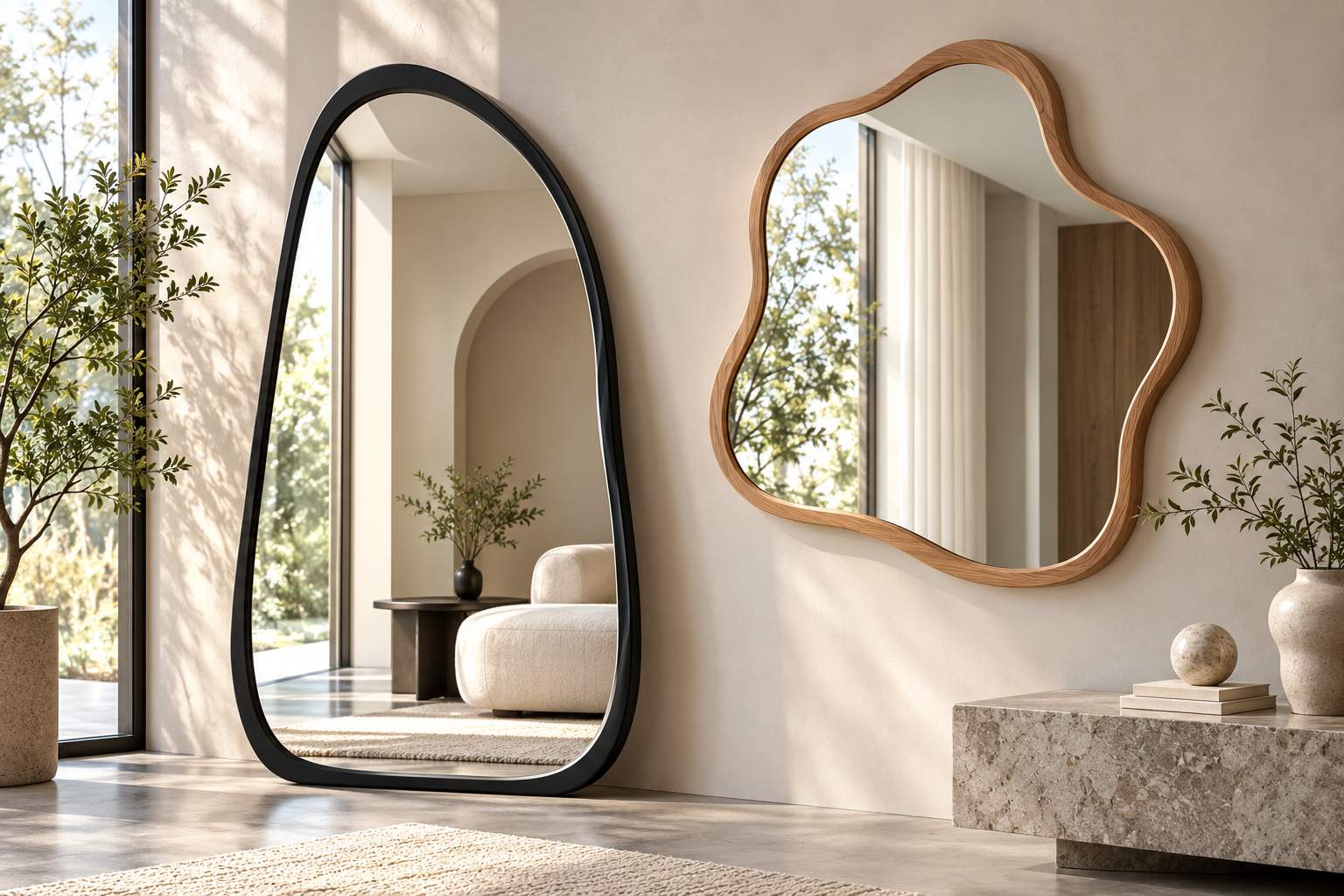
Irregular-shaped mirrors attract attention because they do not rely on the familiar round, rectangular, or arched outline. Pebble shapes, waves, asymmetrical curves, and softer organic forms can help retailers and home décor brands create collections that look more distinctive. The same visual freedom also creates a sourcing challenge: an irregular mirror cannot be controlled by width and height alone. Small changes in curve, proportion, glass position, frame profile, or mounting orientation can noticeably change the finished design. For importers, retailers, private-label brands, and project buyers, bulk ordering therefore requires more than approving a reference image. The shape needs a controlled production reference, and the glass, frame, mounting method, and inspection criteria all need to follow that reference consistently.
Why Does an Irregular Mirror Need More Than Basic Width and Height Dimensions?
Standard mirror shapes are relatively easy to describe. A rectangle can be defined by width, height, and corner radius. A round mirror can be defined by diameter. Irregular shapes are different because the design depends on the relationship between multiple curves.
A supplier can reproduce the same overall width and height while still producing a noticeably different silhouette.
The Outline Should Be Controlled With a Drawing or Template
A buyer should avoid relying only on a photograph, sketch, or verbal instruction such as “make the curve softer.” Those references can communicate style, but they do not provide a repeatable production standard.
For irregular mirrors, a dimensioned drawing, digital outline, approved template, or another controlled reference gives the factory a clearer target. Important turning points, overall dimensions, orientation, and any asymmetric features should remain consistent with the approved design.
This becomes especially important when several sizes are developed from one concept. Simply enlarging every dimension proportionally may not always produce the same visual balance. Buyers reviewing the company’s floor mirror category can see how irregular full-length formats differ from more conventional shapes, but each custom outline still needs its own approved reference.
Orientation Should Be Decided During Development
Some asymmetrical mirrors can be displayed vertically or horizontally, while others only look correct in one direction.
The drawing should therefore identify intended orientation. If both orientations are required, mounting points and visual balance should be checked in both positions rather than assumed.
For retail collections, this matters because customers may interpret an irregular outline differently once the mirror is rotated. The brand should decide whether multi-orientation use is part of the product design or whether the product is intended to have one fixed presentation.
How Should Buyers Check the Relationship Between Glass and Frame?
An irregular mirror may be frameless, fully framed, or built with a decorative structure around the glass. In framed versions, one of the most visible quality points is how evenly the glass follows the surrounding shape.
Small inconsistencies that would be less noticeable on a standard rectangle can stand out along an organic curve.
The Gap Between Glass and Frame Should Look Intentional
If the design includes a visible gap or border, the spacing should remain visually balanced around the mirror.
A buyer should inspect tighter curves, transition areas, and the narrowest points because these are often where misalignment becomes easiest to notice. If the glass sits too close to one side and too far from another, the mirror can look distorted even when the overall dimensions are technically correct.
The manufacturer’s mirror category includes several different frame and shape directions, which is useful for understanding how glass and supporting structures interact across mirror formats.
Frame Construction Should Follow the Approved Curve
For wood or other framed irregular mirrors, the visible outer profile is part of the product identity. The frame should not gradually become more angular, flatter, or less symmetrical from one production unit to another.
During sample approval, buyers should inspect the outline from a distance as well as close up. Looking only at joints and surface finish can miss proportion problems that become obvious when the mirror is viewed as a complete object.
This is one reason the approved sample should be treated as a shape reference, not only as a finish reference.
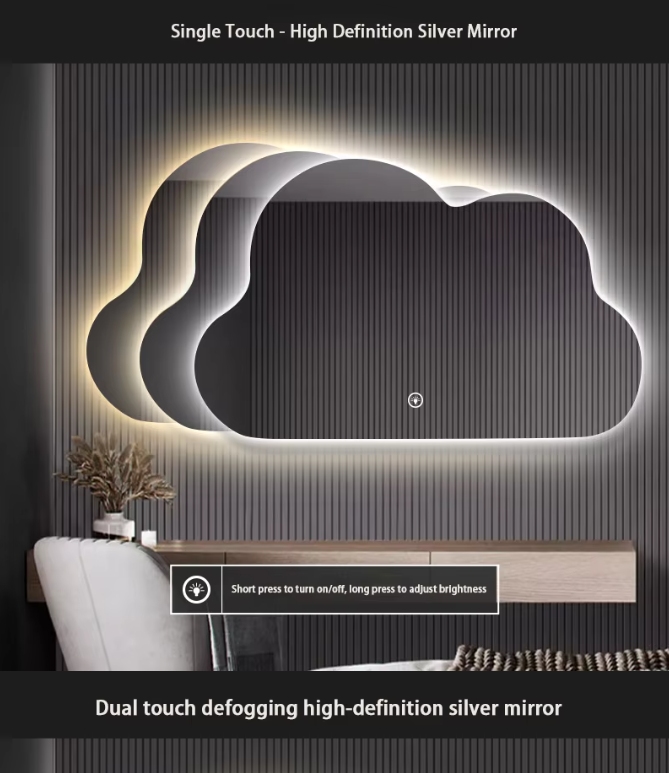
What Glass and Edge Details Matter More on Irregular Shapes?
Irregular outlines introduce more curves and transitions around the glass perimeter. Those areas deserve attention because the edge-processing standard needs to follow a shape that may be much more complex than a standard rectangle.
The glass specification itself should still remain clear and measurable.
Edge Processing Should Be Reviewed Around the Entire Perimeter
If the glass edge is exposed or partially visible, buyers should inspect whether the processing looks consistent through broad curves and tighter sections.
Any grinding, polishing, or beveling requirement should be confirmed on the actual shape rather than approved from a straight-edged glass sample. The product information for the manufacturer’s irregular mirror range lists processing options such as grinding, polishing, drilling, and beveling, which illustrates why edge treatment should be discussed as part of the finished design rather than assumed.
For framed products, the glass edge may be less visible, but it still needs to fit properly within the structure.
Glass Thickness Should Be Fixed Together With the Shape
Large irregular floor mirrors and smaller wall mirrors may not use identical glass specifications.
The manufacturer’s irregular decorative floor mirror page lists 3 mm, 4 mm, and 5 mm silver or aluminum mirror glass options, together with customized sizes. That does not mean every thickness is appropriate for every order. The buyer still needs to confirm which construction belongs to the approved size and frame.
Changing thickness after the sample stage can affect weight, frame fit, handling, and mounting requirements, so it should be treated as a controlled material change.
How Should Mounting and Stability Be Evaluated for Irregular Mirrors?
The center of an irregular mirror may not correspond visually or physically with the center of a standard rectangular bounding box. That can affect mounting position, balance, and how the mirror sits once installed.
The mounting method therefore needs to follow the real geometry of the product.
Wall-Mounted Mirrors Need Balanced Fixing Points
For wall-mounted irregular mirrors, buyers should review the position and number of hooks or brackets on the back.
The manufacturer’s irregular mirror product information notes the use of two metal hooks for balanced suspension and mentions horizontal and vertical installation possibilities for certain designs. For a custom order, however, the buyer should still approve the actual rear layout rather than assuming that one hardware arrangement suits every shape.
A rear-view drawing or photograph can be particularly useful because the front view alone does not reveal how the mirror will hang.
Large Floor Mirrors Need Their Intended Use Checked at Full Size
Irregular full-length mirrors should be reviewed in the position in which customers will use them.
A mirror may look visually balanced when photographed upright but behave differently when leaning, standing, or viewed at an angle. Buyers should therefore check overall stability, frame contact points, rear construction, and whether the product remains visually straight in its intended position.
The products page can help buyers compare large-format mirror directions before settling on a particular construction.
What Should Buyers Approve Before Irregular Mirrors Enter Mass Production?
The biggest risk in an irregular mirror order is that everyone remembers the general idea but not the exact approved shape.
The final approval should therefore connect the visual sample with documents that can be used later by production and inspection teams.
Shape, Finish, and Construction Should Be Approved Separately
A buyer may approve the overall silhouette but still request a finish correction. Later, someone may treat the revised finish sample as permission to change the shape as well.
Keeping the controls separate avoids this confusion. The final record should identify the approved outline, dimensions, glass specification, frame construction, finish, orientation, mounting arrangement, and any visible edge requirements.
If the order contains several sizes, each size should be linked to the correct drawing rather than being described only as small, medium, and large.
Inspection Should Use the Same Shape Reference as Production
An inspector cannot reliably judge an irregular curve with a sentence such as “shape should look right.”
The approved drawing, template, or golden sample should be available as the comparison standard. Inspectors can then check overall dimensions, key contour points, glass-to-frame alignment, finish, mounting position, and visible workmanship.
If a later repeat order changes the outline, even slightly, that change should receive its own revision rather than quietly replacing the earlier specification.
Professional Technical Support
Irregular mirror development often requires closer control of shape, glass fit, frame construction, orientation, and mounting than a conventional round or rectangular design. Qingdao Yinlongfei Handicraft Co., Ltd. supports OEM and ODM mirror projects for overseas buyers and publishes customized size, shape, glass, frame, finishing, and installation options across its mirror range. Buyers who need a concrete reference during development can review the Manufacture Irregular Decorative Wood Floor Mirror page. The production order should still be based on the buyer’s approved drawing and sample so that the finished bulk quantity follows the intended silhouette rather than a general interpretation of an “irregular” shape.
Conclusion
Irregular-shaped mirrors create differentiation because their outline becomes part of the product identity, but that same feature needs tighter control during sourcing. Buyers should define the shape with a repeatable reference, check how glass and frame follow the curves, confirm edge processing and thickness, and review mounting or stability on the finished sample. Once those details are documented, inspection becomes much more objective. The goal is not simply to receive mirrors with approximately the same width and height, but to reproduce the same recognizable design across the full bulk order.
FAQs
1. Is a Reference Photo Enough to Produce an Irregular Mirror?
Usually not for bulk production. A reference photo communicates style, but a controlled drawing, template, or approved sample gives the manufacturer a more repeatable shape standard.
2. Should Every Irregular Mirror Size Have Its Own Drawing?
Yes, when the outline or proportion changes by size. Buyers should avoid assuming that enlarging one shape automatically creates the correct visual balance for another size.
3. What Should Buyers Inspect Around the Curved Glass Edge?
Check processing consistency, visible chips or defects, glass-to-frame fit, exposed edge appearance, and whether tighter curves match the approved sample.
4. Can Irregular Mirrors Be Installed Horizontally and Vertically?
Some designs can, but buyers should confirm orientation and mounting points during development. Both positions should be tested if dual-orientation installation is part of the specification.
5. How Can Inspectors Check Whether an Irregular Shape Is Correct?
Use the approved drawing, template, or golden sample to compare overall dimensions, key contour points, frame alignment, mounting position, and the complete silhouette.